

How To Evaluate A Sunglasses Manufacturer Before Placing A Bulk Order: A B2B Buyer’s Verification Checklist

To evaluate a sunglasses manufacturer before placing a bulk order, verify five things: project fit, material and lens specifications, customization and sampling capability, quality-control procedures, and market-specific compliance documents. Do not approve a supplier based only on price, catalog photos, or a certificate list. Your final decision should be based on a confirmed sample, written specifications, traceable test evidence, and an agreed pre-shipment inspection standard.
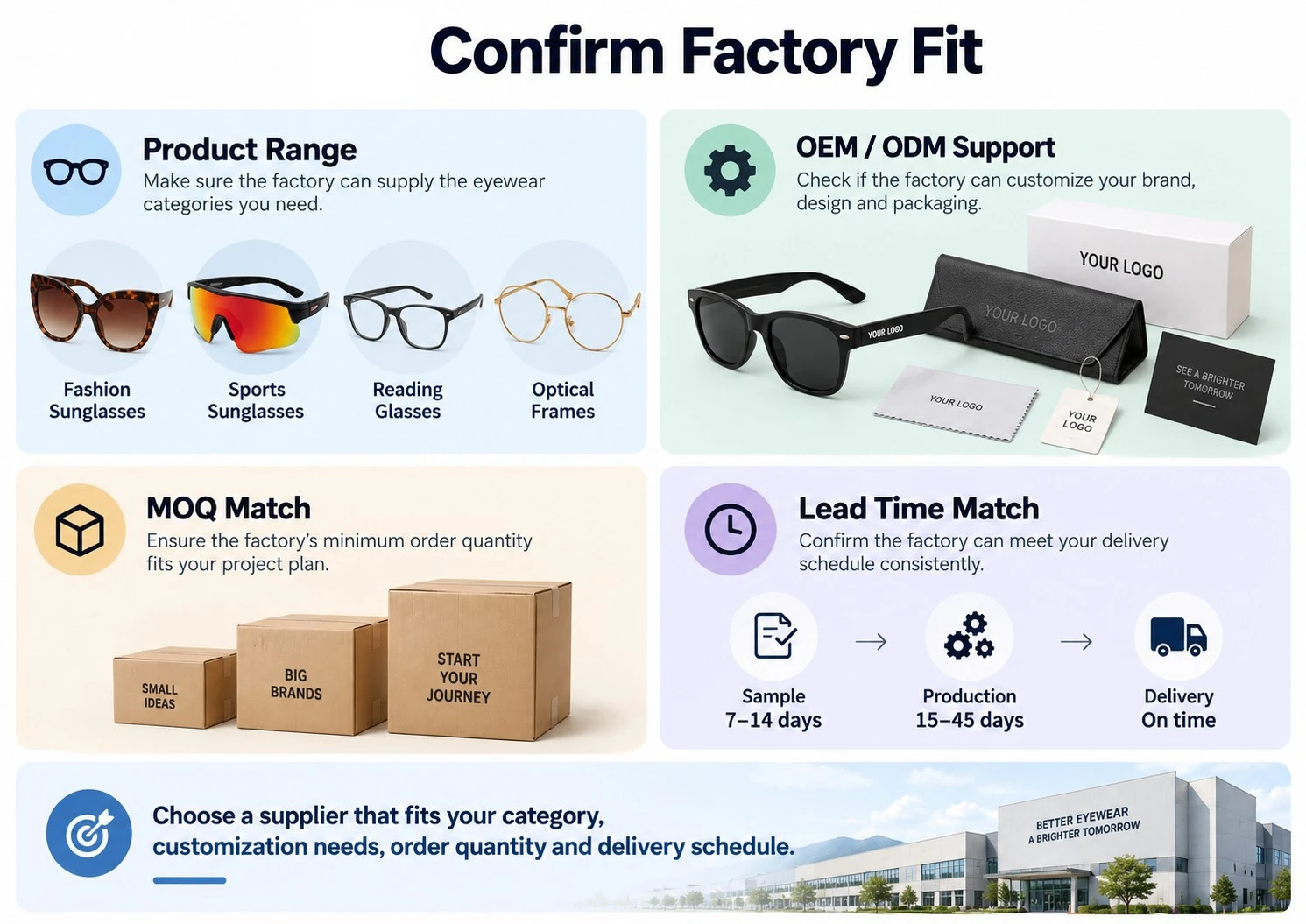
1. First Confirm Whether the Manufacturer Fits Your Project
A factory can make good sunglasses and still be the wrong supplier for your order.
A buyer sourcing 20,000 promotional sunglasses has very different requirements from a premium acetate brand developing 500 custom frames. Likewise, a supplier specializing in fashion sunglasses may not be suitable for an industrial safety eyewear program.
Before comparing quotations, confirm what the factory actually produces.
Ask which categories represent regular production rather than occasional outsourced orders:
- Fashion sunglasses
- Polarized sunglasses
- Sports sunglasses
- Reading glasses
- Optical frames
- Acetate eyewear
- Safety or protective eyewear
Then confirm the development model.
Some buyers only need an existing model with their logo. Others want to change colors, lenses and temple details. A full OEM project may start from a sketch, CAD drawing, reference sample or completely new mold.
These are not the same manufacturing task.
Three Common Eyewear Development Models
| Project Type | What the Buyer Provides | What the Manufacturer Should Handle |
|---|---|---|
| Private Label | Existing frame selection + logo | Logo, lens option, packaging and production |
| Modified ODM | Reference style + changes | Frame color, lens, hardware, logo and selected structural changes |
| Full OEM | Drawing, sample, CAD or concept | Engineering, prototyping, tooling, sampling and production |
A useful supplier should tell you which route is commercially sensible instead of automatically pushing you toward the most expensive option.
Check MOQ, Quantity and Lead Time at the Same Time
MOQ should never be discussed as an isolated number.
Ask:
- What is the MOQ per model?
- What is the MOQ per color?
- Does a custom lens color have a separate MOQ?
- Does custom packaging change the MOQ?
- Is the MOQ different for existing molds and new molds?
- What production lead time applies to your actual quantity?
A factory saying "MOQ 300" means very little if your project requires four custom frame colors, three lens colors and individual branded packaging.
The conclusion is simple: confirm MOQ against your exact configuration, not against a generic catalog quotation.
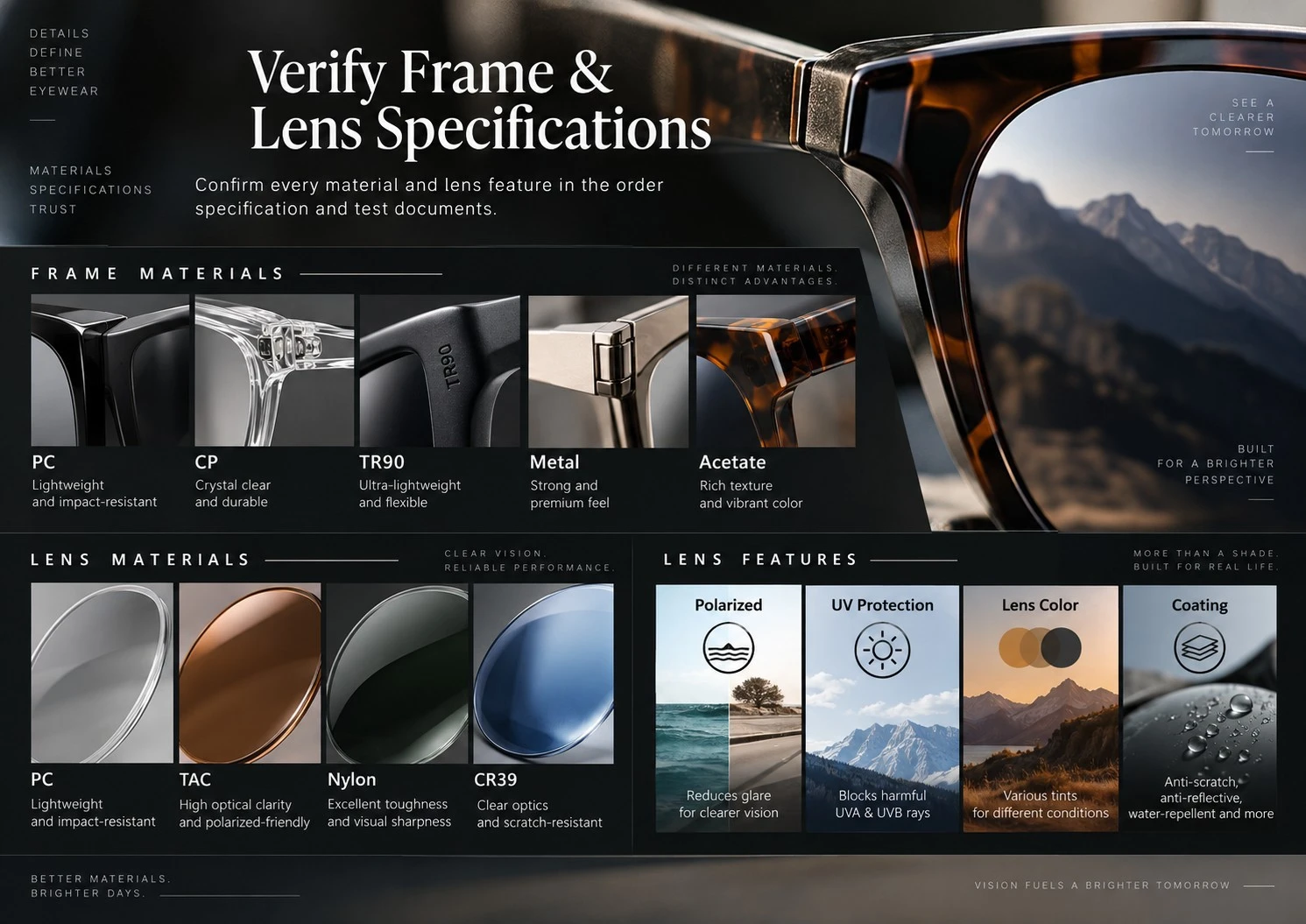
2. Verify Frame Materials and Lens Specifications
One of the fastest ways to expose an inexperienced sunglasses supplier is to ask detailed material questions.
A reliable factory should be able to explain what material is being quoted, why it suits the product and what alternatives are available.
Frame Materials
Common options include:
- PC: Widely used for injection-molded fashion and promotional sunglasses.
- CP: Used in various injection-molded eyewear applications where cost and styling requirements differ.
- TR90: Common where buyers want lightweight and flexible frame characteristics.
- Metal: Suitable for aviator, retro, fashion and mixed-material constructions.
- Acetate: Often selected for higher-value collections where buyers prioritize surface finish, color depth and premium positioning.
Do not accept "plastic frame" as the final specification.
Your purchase order should state the material clearly.
Lens Materials
Common sunglass lens options include:
- PC lenses: Frequently used for lightweight eyewear and products requiring practical impact performance.
- TAC lenses: Commonly selected for polarized fashion sunglasses.
- Nylon lenses: Often considered for products where optical appearance, curvature or premium sports applications are important.
- CR39 lenses: Used in selected optical and premium eyewear applications.
The material name alone is still not enough.
Your RFQ should also specify:
- Polarized or non-polarized
- Lens color
- Filter category where applicable
- UV protection requirement
- Mirror coating
- Gradient treatment
- Anti-scratch coating
- Anti-fog requirement
- Other functional coatings
This leads to an important purchasing rule:
Do not approve claims such as "UV400," "polarized" or "impact resistant" simply because they appear in a product description.
Write the required performance into the order specification and request appropriate test evidence for the product when needed.
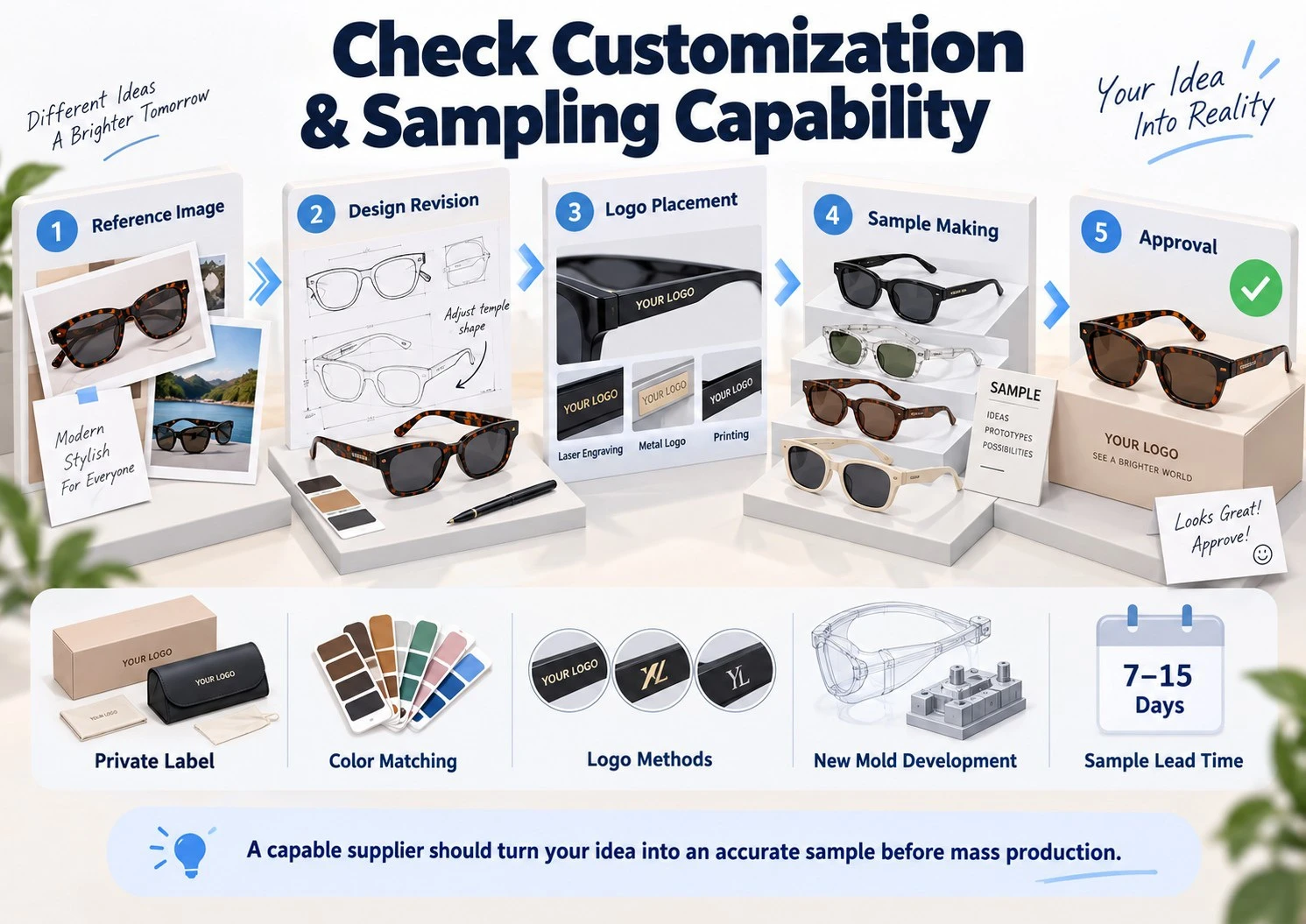
3. Check Customization and Sampling Capability
Customization capability is easier to evaluate through a sample than through a presentation.
If the factory says it supports OEM and ODM sunglasses, give the team a realistic development task and see how they handle it.
Check Logo Options
Typical eyewear branding methods can include:
- Silk screen printing
- Hot stamping
- Laser / Laser painting
- 3D metal logo
- Metal badge or decorative component
- Customized packaging and labels
The correct process depends on the frame material, logo size, surface and desired retail positioning.
For example, a tiny laser logo and a raised metal temple emblem may both display your brand name, but they create completely different product positioning and cost structures.
Confirm Color With a Defined Reference
"Dark green" is not a production specification.
Where possible, use:
- Pantone references
- Physical color samples
- Approved material swatches
- Approved master samples
Color matching is especially important when several materials appear on the same frame. A metal component, injected plastic temple and coated lens may react differently even when the same visual color direction is requested.
Your pre-production sample becomes the reference that connects design intent to bulk production.
What Should Be Approved on the Pre-Production Sample?
Before releasing bulk production, confirm:
| Checkpoint | What to Approve |
|---|---|
| Frame | Shape, dimensions, fit and material |
| Frame Color | Approved color reference |
| Lens | Material, color, polarization and coating |
| Logo | Size, location, color and process |
| Hardware | Hinge, screw and decorative parts |
| Packaging | Case, pouch, cloth, box and insert |
| Labels | Barcode, model, warnings and market information |
Take photographs and keep the approved specifications with the purchase order.
For complicated OEM projects, keep one signed or otherwise clearly identified "golden sample" as the production reference.
That reduces one of the most common disputes in eyewear sourcing: the supplier saying the bulk product is acceptable while the buyer compares it with a different version of the sample.
4. Verify the Manufacturer's Quality-Control Process
A good sample proves that the manufacturer can make one good unit.
It does not prove that the factory can make 5,000 consistent units.
That is why bulk-order verification must include the QC process.
Frame and Mechanical Inspection
Ask the supplier how inspectors check:
- Temple alignment
- Temple opening and closing
- Hinge movement
- Nose pad position
- Lens retention
- Frame deformation
- Surface finish
Put a finished pair on a flat surface. Uneven temples or obvious frame twisting can quickly reveal assembly or adjustment problems.
For metal styles, pay additional attention to soldering, plating and component alignment.
For acetate styles, inspect polishing, edge finishing and symmetry.
Lens Inspection
Lens problems are particularly expensive because consumers notice them immediately.
Inspection should cover:
- Visible scratches
- Coating defects
- Lens installation
- Lens color consistency
- Edge gaps
- Lens functions (if applicable)
Branding and Packaging Inspection
QC should not stop after the eyewear passes inspection.
Check:
- Logo position and orientation
- Logo printing clarity
- Correct packaging
- Barcode readability
- Model number
- Color code
- Quantity per inner box
- Quantity per carton
- Carton marks
- Required warning or compliance information
Imagine receiving 3,000 correctly manufactured sunglasses with the wrong barcode.
The sunglasses themselves may pass QC, but your retailer can still reject the shipment.
For B2B buyers, packaging data is part of product quality.
5. Confirm Compliance and Delivery Documents for Your Market
One of the biggest sourcing mistakes is asking:
"Do you have CE?"
A better question is:
"What requirements apply to this specific product in the market where I will sell it, and which documents support this exact model?"
General-Use Sunglasses and Safety Eyewear Are Different
General sunglasses designed to protect against sunlight and occupational protective eyewear serve different purposes.
ISO 12312-1 applies to sunglasses for general use and specifically excludes occupational eye protection. ISO 16321-1 addresses eye and face protection intended for occupational hazards.
That distinction matters when reviewing a supplier's test library.
For example, ANSI Z87.1, AS/NZS 1337.1, CSA Z94.3 or ISO/EN ISO 16321-related documentation may be relevant to particular protective-eyewear programs, but these should not simply be presented as universal requirements for every fashion sunglass order.
European Union Orders
In the EU, PPE Regulation (EU) 2016/425 identifies protection against eye damage from sunlight, other than direct observation of the sun, within Category I risks. The regulation also sets out conformity-assessment and manufacturer obligations.
CE marking should therefore not be treated as a decorative certificate logo.
The European Commission also makes clear that CE marking does not mean a product has been individually "approved" as safe by the EU. Manufacturers need to follow the applicable conformity process and supporting documentation requirements.
United States Orders
For sunglasses sold in the United States, buyers should verify FDA compliance before bulk production and shipment.
Key checks include:
- FDA establishment registration and device listing, where applicable
- Lens impact-resistance testing under 21 CFR 801.410
- Required labeling and shipment documentation
- Confirmed lens specifications, including UV protection, polarization and coatings
For safety eyewear, ANSI Z87.1 should be evaluated separately based on the product's intended use.
Do not simply ask whether a supplier "has FDA." Confirm that the manufacturer, product, testing and shipment documents all match your U.S. order requirements.
Because marking rules can change, buyers should always confirm the current requirements for their destination before approving
What Finewell Can Provide for Buyer Review
Depending on the eyewear category and project, Finewell's available compliance documentation and test reports include materials related to:
- CE
- UKCA
- ANSI Z87.1
- AS/NZS 1337.1
- CSA Z94.3
- EN ISO 16321-1
- FDA-related requirements
- Drop ball testing
- UV400 testing
- Anti-blue light testing
- BSCI
- ISO 9001
The important point is not the length of the certificate list.
A professional buyer should confirm whether the document applies to the requested model, material, lens configuration, intended use and destination market.
Never assume that one report automatically covers every frame in a supplier's catalog.
6. Put Compliance Requirements Into Your RFQ
Do not wait until production finishes to discuss testing.
Your RFQ should state:
- Product: Polarized fashion sunglasses
- Destination Market: EU
- Frame Material: Acetate
- Lens Material: TAC
- Lens Requirement: Polarized, specified color and UV protection
- Required Standard or Market Requirement: To be confirmed before sample approval
- Required Documents: Applicable test report, declaration or supporting compliance documentation
- Packaging Requirements: Buyer-approved labels and market information
This gives the manufacturer enough information to quote the correct product rather than quoting a basic version first and adding testing, labeling and packaging costs later.
FAQ
How do I know whether a sunglasses manufacturer is reliable?
Do not judge reliability from the website alone.
Check whether the supplier can explain materials, production methods, customization limitations, QC procedures and applicable compliance requirements clearly. Then verify those claims through samples, documents and a written order specification.
Consistency between what the salesperson says, what the sample shows and what the documentation proves is a much stronger signal than a low quotation.
Should I ask for a factory audit?
For larger programs, retailer supply chains or long-term sourcing relationships, reviewing factory and quality-management documentation can be useful.
Documents such as BSCI audit information and ISO 9001 quality-management documentation answer different questions from product test reports. They help evaluate the manufacturing organization, but they do not replace product-specific testing.
How can I verify polarized sunglasses?
First specify polarization in the purchase order rather than simply asking for "dark lenses."
Ask the manufacturer to identify the lens construction and provide appropriate test evidence where required. Your approved sample should also establish the visual appearance and lens configuration expected in production.
Does ANSI Z87.1 apply to every pair of sunglasses sold in the United States?
Do not automatically apply an occupational safety-eyewear specification to ordinary fashion sunglasses.
General sunglasses and occupational protective eyewear have different intended uses. If you are developing safety eyewear, the required standard should be written into the RFQ from the beginning.
Should I approve a bulk order only from photos?
For a new supplier or customized project, a physical sample is normally much safer.
Photos can confirm appearance, but they cannot adequately show hinge movement, frame balance, lens distortion, surface feel, fitting or packaging construction.
A sample costs far less than correcting thousands of finished units.
Conclusion - Compare Landed Cost, Not Just Sunglasses Price
The cheapest sunglasses quotation is not necessarily the lowest-cost order.
A slightly cheaper supplier can become expensive very quickly if you later discover incorrect lens specifications, inconsistent logos, scratched coatings, missing documentation, wrong barcodes or production delays.
Before placing a bulk order, verify the manufacturer through five layers:
project fit, material specifications, sample capability, quality control and market compliance.
Then freeze the approved requirements in writing.
At Finewell Eyewear, buyers can start with existing wholesale sunglasses, modify current designs or develop OEM/ODM eyewear from reference samples and drawings. We can also review your target market, lens requirements, branding and packaging before the sample stage so that compliance and production requirements are identified earlier.
If you are comparing suppliers, send us your target style, quantity, market and customization requirements.
We can prepare three practical sourcing options for comparison:
- Existing model + private label
- Modified ODM solution
- Full OEM development
This makes it easier to compare MOQ, development cost, lead time and customization level before committing to bulk production.


