

How To Build A Sports Sunglasses Collection For Retail: Frames, Lenses And Assortment By Activity

A strong sports sunglasses collection should be built around how customers actually use the eyewear-not around how many frame styles appear in a supplier's catalog.
Running, cycling, fishing, hiking and other outdoor activities expose the wearer to different combinations of speed, wind, reflected light, changing illumination, perspiration and movement. That means the same sport sunglasses should not automatically be positioned for every activity.
For retailers and eyewear brands, the better buying sequence is:
Activity → Wearing Environment → Frame Structure → Lens Specification → Price Tier → SKU
This approach produces a smaller but more commercially useful assortment. It also makes product descriptions clearer, reduces duplicated SKUs and gives customers a real reason to move from an entry-level model to a premium option.
Start With the Activity, Not the Sunglasses Style
One of the most common assortment mistakes is buying ten visually different sports sunglasses that solve essentially the same problem.
A retailer may select:
three shield designs,
four wraparound frames,
several lens colors,
and two mirrored styles,
yet discover that almost every SKU is being marketed as "cycling, running, fishing, golf and hiking sunglasses."
The catalog looks large, but the product logic is weak.
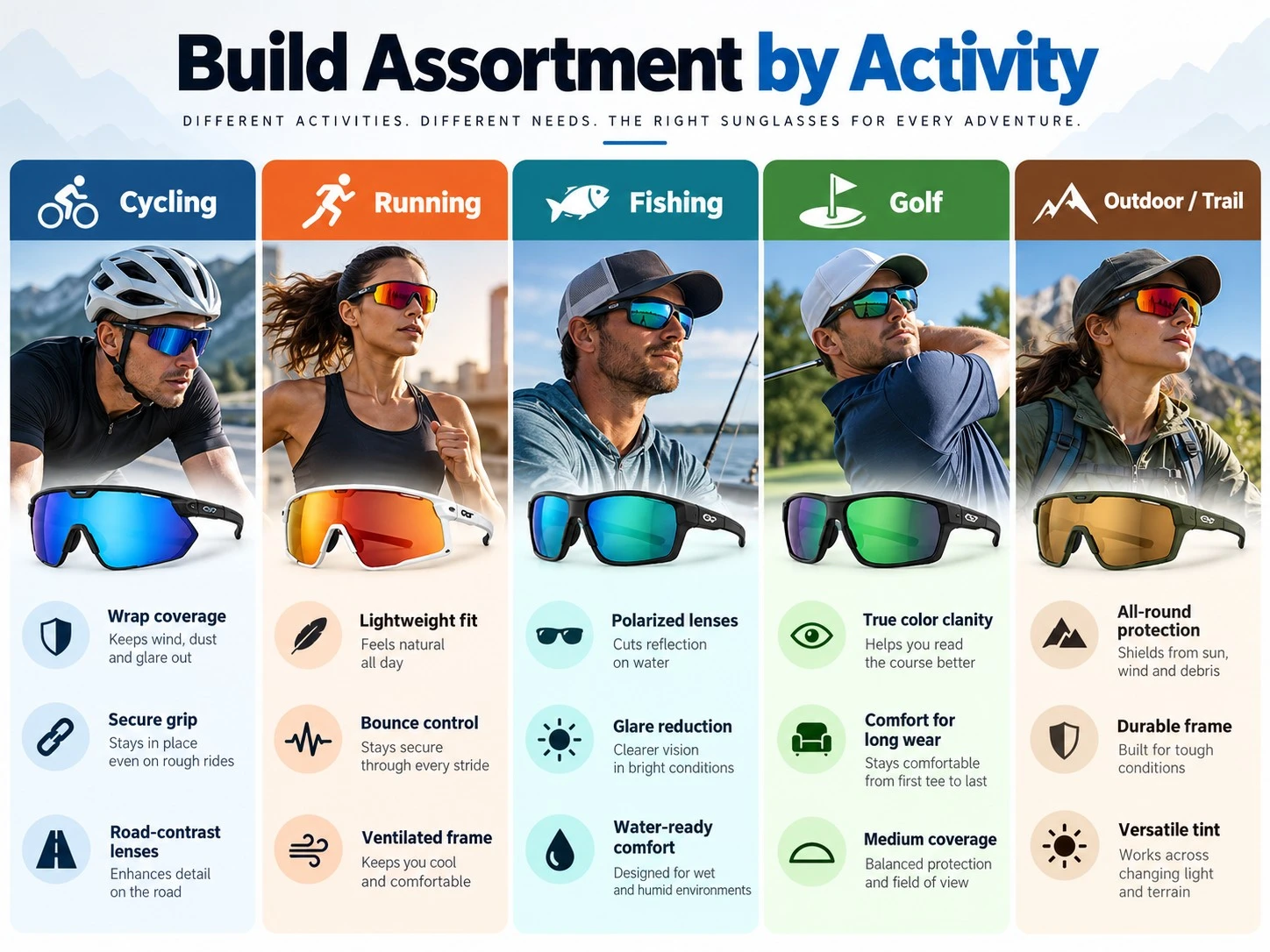
A better sports eyewear assortment starts by asking what changes between activities.
| Activity | Main Wearing Conditions | Primary Product Priorities |
|---|---|---|
| Road cycling | Speed, wind, changing sunlight, helmet use | Wide field of view, secure fit, coverage, ventilation |
| Trail running | Constant head movement, sweat, shade-to-sun transitions | Lightweight frame, grip, ventilation, adaptable lens choice |
| Fishing / boating | Strong reflected light from water, long exposure | Polarization, coverage, secure fit |
| Hiking | Long wear, changing terrain and weather | Comfort, UV protection, moderate coverage, durability |
| Golf | Long wear, head movement, cap compatibility | Lightweight fit, clear field of view, comfortable temple design |
| Active lifestyle / beach | Bright sunlight, casual activity, style influence | UV protection, polarization option, commercial styling |
The key point is simple: activity defines the problem; the product specification solves it.
This is especially important for buyers building a wholesale sports sunglasses range.
A fishing customer may immediately understand why a polarized model costs more than a basic tinted model. A cyclist may pay more for better coverage, grip and ventilation. A runner may value lightweight construction more than an oversized mirrored lens.
That gives every SKU a commercial role instead of making every model compete on appearance alone.
Do Not Confuse Sports Styling With Protective Sports Eyewear
"Sports sunglasses" is often used as a retail category, but not every product with a wraparound frame is protective eyewear for high-impact sports.
ISO 12312-1:2022 covers sunglasses for general use but explicitly excludes certain eye protectors intended for specific sports. Ski and snowboard goggles, for example, are addressed by ISO 18527-1. ASTM F803-25 covers eye protectors for selected sports including basketball, baseball and soccer, with specific optical and mechanical performance requirements.
For buyers, this distinction matters.
If you are selling ordinary outdoor sunglasses for cycling, running or hiking, do not automatically market them as certified protective eyewear for ball sports, industrial environments or other high-impact applications unless the product has been designed and tested for the relevant requirement.
That protects both your customer and your brand.
Choose the Frame Structure Before Choosing the Color
Frame color is easy to change.
Frame geometry is much harder to fix after you discover that the eyewear slips, traps heat or leaves too much peripheral exposure.
That is why buyers should evaluate the structure first.
Coverage
For outdoor sports, greater coverage can help reduce light entering from the side and improve protection from wind and airborne particles.
WHO specifically recommends wraparound-style sunglasses for improved UV protection because they reduce exposure around the sides of the eyes.
For cycling and other higher-speed outdoor activities, this also creates a practical retail benefit: a larger lens or wrap profile can provide a more enclosed visual area than a small fashion frame.
However, maximum coverage is not always the goal.
A large shield that works well for cycling may feel excessive for golf or casual hiking. Product structure should match the use case rather than following one design formula.
Retention and Grip
Movement changes how a frame should fit.
For running, cycling and hiking models, buyers should pay particular attention to:
- temple grip,
- nose-pad contact area,
- frame balance,
- pressure behind the ears,
- frame width,
- and compatibility with helmets or caps.
A frame that feels comfortable while standing still may move once the wearer begins sweating or repeatedly looking downward.
This is why sample evaluation should include actual movement rather than only a desk inspection.
Ventilation
More coverage can create another problem: reduced airflow.
This is particularly important on large wraparound and shield-style frames.
Ventilation can come from the relationship between the lens and face, strategically designed openings or the overall curvature and positioning of the frame.
The goal is not simply "more ventilation."
Too much open space may reduce coverage. Too little airflow can make the product uncomfortable in humid or high-output activities.
The correct structure is a balance between coverage, airflow and stability.
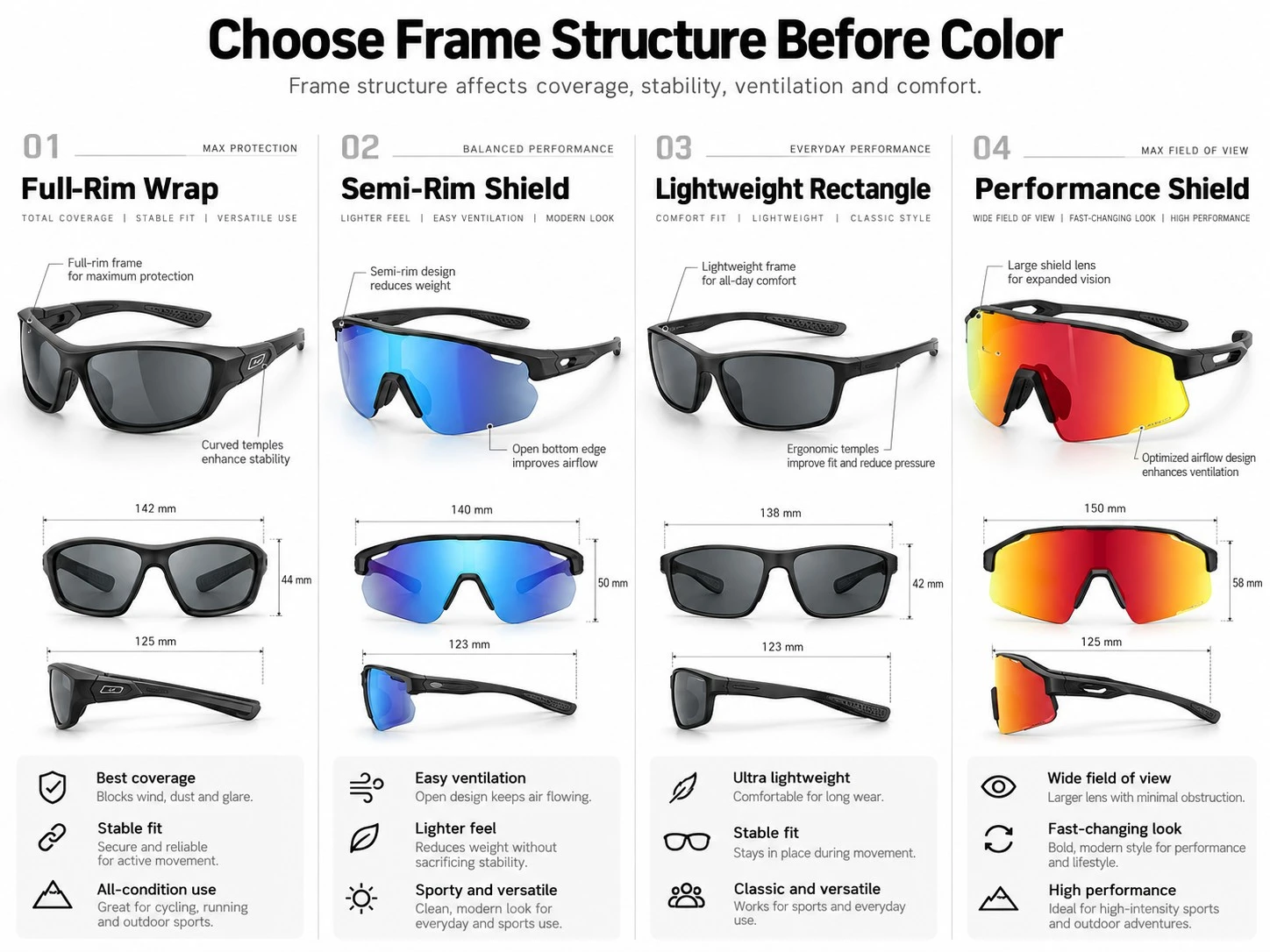
Full-Frame, Half-Frame or Shield?
Each architecture creates a different product position.
| Structure | Best Commercial Use | Buyer Consideration |
|---|---|---|
| Full-frame wrap | Outdoor, fishing, running, general sport | Familiar construction and good lens retention |
| Half-frame | Cycling, running, performance styling | Open lower field and lightweight appearance |
| One-piece shield | Cycling, racing, fashion-performance crossover | Large visual area and strong shelf impact |
| Compact sport wrap | Hiking, golf, casual outdoor | Easier everyday positioning |
Do not order four frame architectures simply because all four are available.
Choose the structures that solve different customer needs.
Match Lens Technology to the Environment
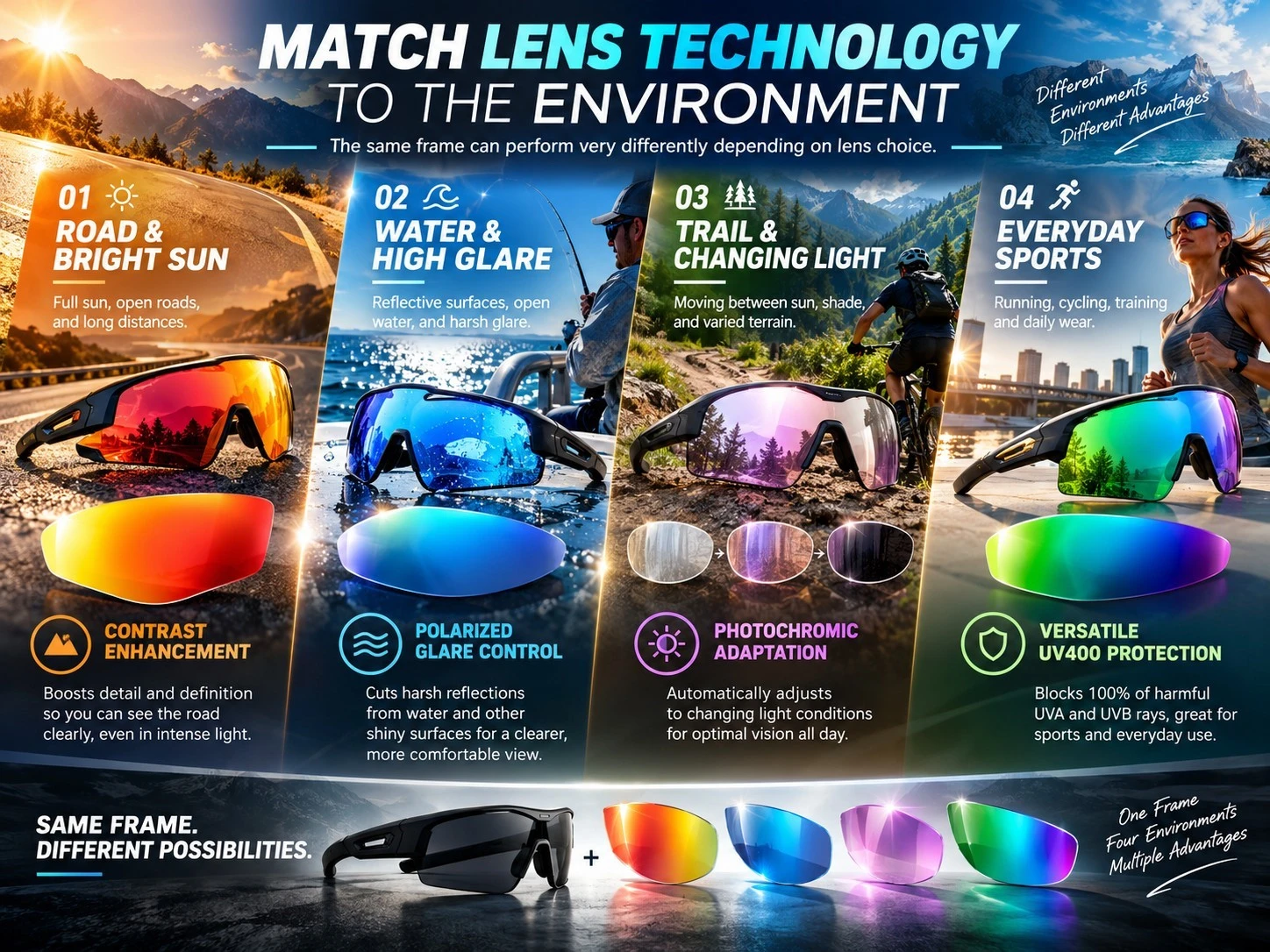
After selecting the frame platform, move to the lens.
The question should not be:
"Which lens looks premium?"
It should be:
"What visual environment is this SKU designed for?"
UV Protection Comes First
Lens darkness should never be used as proof of UV performance.
WHO states that UV protection cannot be judged from lens darkness, color or price and recommends lenses that absorb UV-A and UV-B radiation through 400 nm-commonly associated with UV400 protection.
For a wholesale buyer, that means UV claims should be treated as a specification to verify, not simply a printed marketing phrase.
This becomes even more important in highly reflective environments.
The U.S. EPA notes that snow, water, sand and pavement can reflect UV radiation and increase the amount reaching the eyes.
Polarized Lenses: Give Them a Clear Job
Polarized lenses make the most commercial sense when reflected glare is a major part of the use environment.
Fishing and boating are obvious examples.
Instead of offering polarized lenses across every SKU merely to make the range appear premium, use them where customers can clearly understand the benefit.
A retailer can then communicate:
Entry fishing model: UV-protective sport lens
Core fishing model: polarized lens
Premium fishing model: polarized lens plus upgraded frame, coating or fit features
Now the price ladder has logic.
Polarization should also be treated separately from UV protection. A buyer should verify both specifications rather than assuming one automatically proves the other.
Mirrored Lenses
Mirror finishes are useful for creating visible product differentiation, especially in cycling, running and performance-fashion categories.
They can turn one frame platform into several visually distinct retail options without creating an entirely new mold or frame architecture.
However, avoid creating five mirror colors before the base model has proven sell-through.
For an initial order, one or two commercially safe lens colors normally give the buyer more useful sales data than a wide color spread across small quantities.
Photochromic Options
Photochromic lenses are particularly interesting for use cases where lighting changes during the activity.
Examples include:
- early-morning cycling,
- trail running through mixed shade,
- long rides extending toward evening,
- or outdoor conditions that shift from overcast to brighter light.
The commercial value is convenience: one product can cover a broader range of light conditions.
Coatings Should Solve a Problem
Additional treatments may include:
- hard coating,
- anti-fog treatment,
- hydrophobic treatment,
- mirrored finishing,
- or other surface options.
Do not add every coating to every model.
Each upgrade should either improve the use case or support a higher retail price.
Build the Sports Sunglasses Collection by Activity
Once the basic frame and lens logic is clear, buyers can create small product families around major activities.
Cycling Sunglasses
Cycling is a strong category for large shield and wraparound frames because the wearer deals with speed, airflow, sunlight and frequent head movement.
A practical cycling range could include:
Core model
- large lens coverage,
- secure temple fit,
- non-slip nose contact,
- UV-protective lens,
- two commercially proven frame colors.
Upgraded model
- stronger lens package,
- mirror finish or polarized option where appropriate,
- upgraded grip components,
- alternative lens configuration.
Premium model
- photochromic or other advanced lens option,
- more refined frame construction,
- premium packaging or accessories.
Avoid creating five almost identical cycling shields at the same price.
Give each model a reason to exist.
Running Sunglasses
Running eyewear should prioritize low perceived weight and stable fit.
The wearer repeatedly moves vertically and may generate substantial perspiration, so test:
- nose-pad security,
- temple movement,
- frame bounce,
- ventilation,
- and pressure after extended wear.
For retail, two frame shapes with meaningful lens differences are often stronger than six similar frames differentiated only by color.
Fishing and Boating Sunglasses
This category gives buyers one of the clearest reasons to create a polarized tier because reflected light from water is part of the wearing environment.
EPA and WHO both identify bright reflective surfaces, including water, as an important consideration for UV exposure.
Product priorities normally include:
- good side coverage,
- stable fit,
- polarization where required,
- comfortable long-duration wear,
- and practical lens colors for the target consumer.
For a fishing-focused brand, it may make more sense to invest in three strong polarized models than ten general outdoor sunglasses.
Hiking and General Outdoor Sunglasses
Hiking buyers often need versatility more than an extreme racing appearance.
A moderately wrapped lightweight frame can therefore reach a wider customer base than a highly aggressive cycling shield.
This category is also useful as the bridge between technical sport eyewear and everyday retail.
That makes it suitable for buyers who want a sports sunglasses collection without moving entirely into specialist performance products.
Golf Sunglasses
Golf eyewear needs a slightly different product balance.
Extreme coverage and aggressive aerodynamics are less important than:
- comfortable long wear,
- stable fit during head movement,
- low frame distraction,
- and compatibility with hats or caps.
This is a good example of why one sports frame should not automatically be marketed for every activity.
A cycling frame and golf frame may both provide UV protection, but their optimal shape and merchandising story can be different.
Build Good, Better and Best Product Tiers
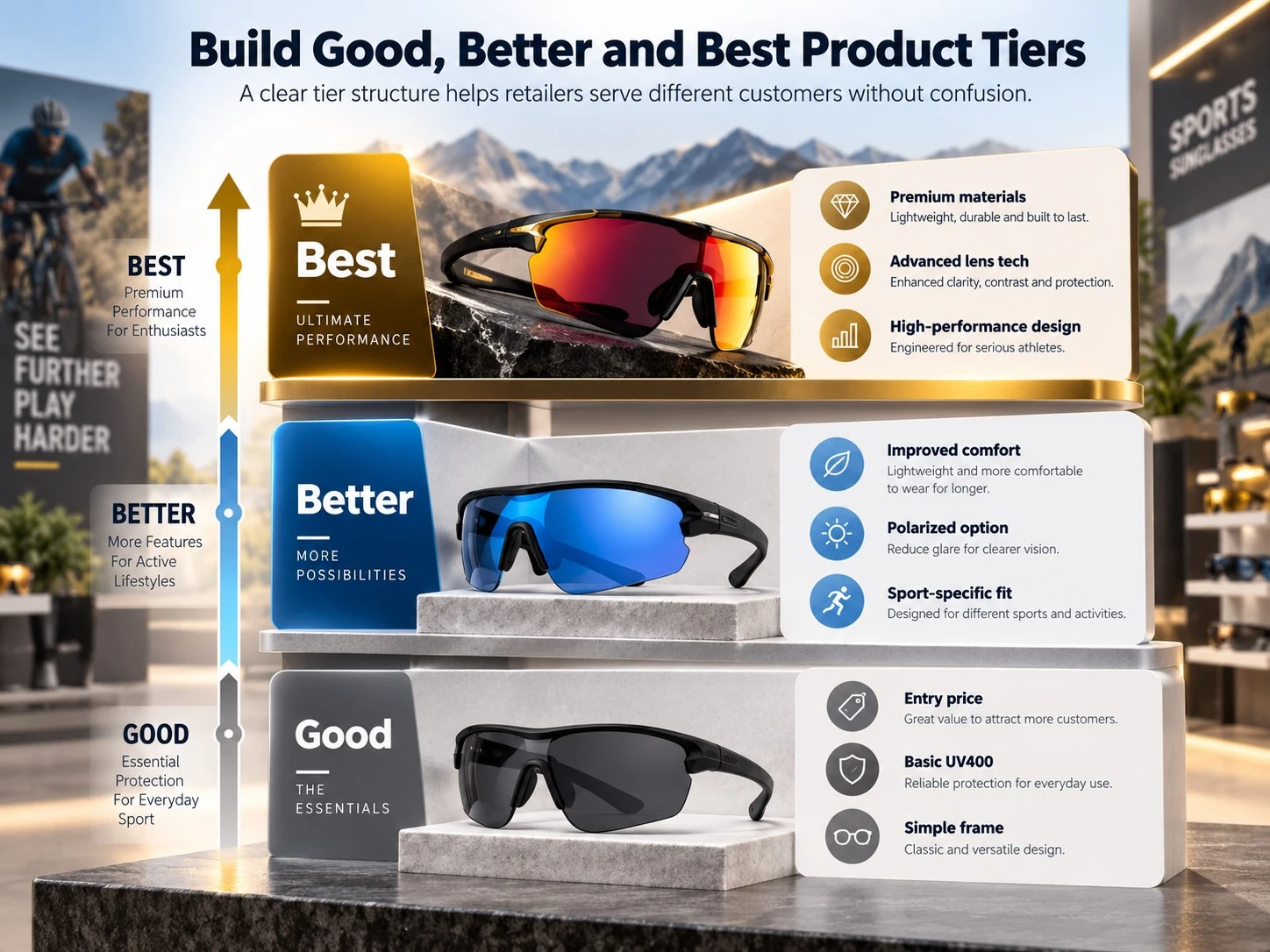
A successful assortment should give customers a visible reason to trade up.
Do not create price differences without product differences.
Use a simple three-tier architecture.
| Tier | Role | Typical Specification Strategy |
|---|---|---|
| Good | Entry / volume | Proven sport frame, UV-protective lens, limited colors |
| Better | Main seller | Improved frame fit, polarization or upgraded lens/coating, stronger styling |
| Best | Premium / halo | Higher-spec lens platform, refined components, premium finish and packaging |
The middle tier should usually carry the widest commercial appeal.
The entry model brings customers into the category.
The premium model establishes the value ceiling.
The middle model then appears easier to justify.
This is much more effective than showing customers six similar sunglasses priced only a few dollars apart with no obvious functional difference.
For B2B buyers, the same structure also makes purchasing easier.
Instead of asking a supplier:
"Send me your best sports sunglasses."
You can ask:
"I need an entry, core and premium cycling range for a $39–$99 retail price architecture."
That is a much more useful sourcing brief.
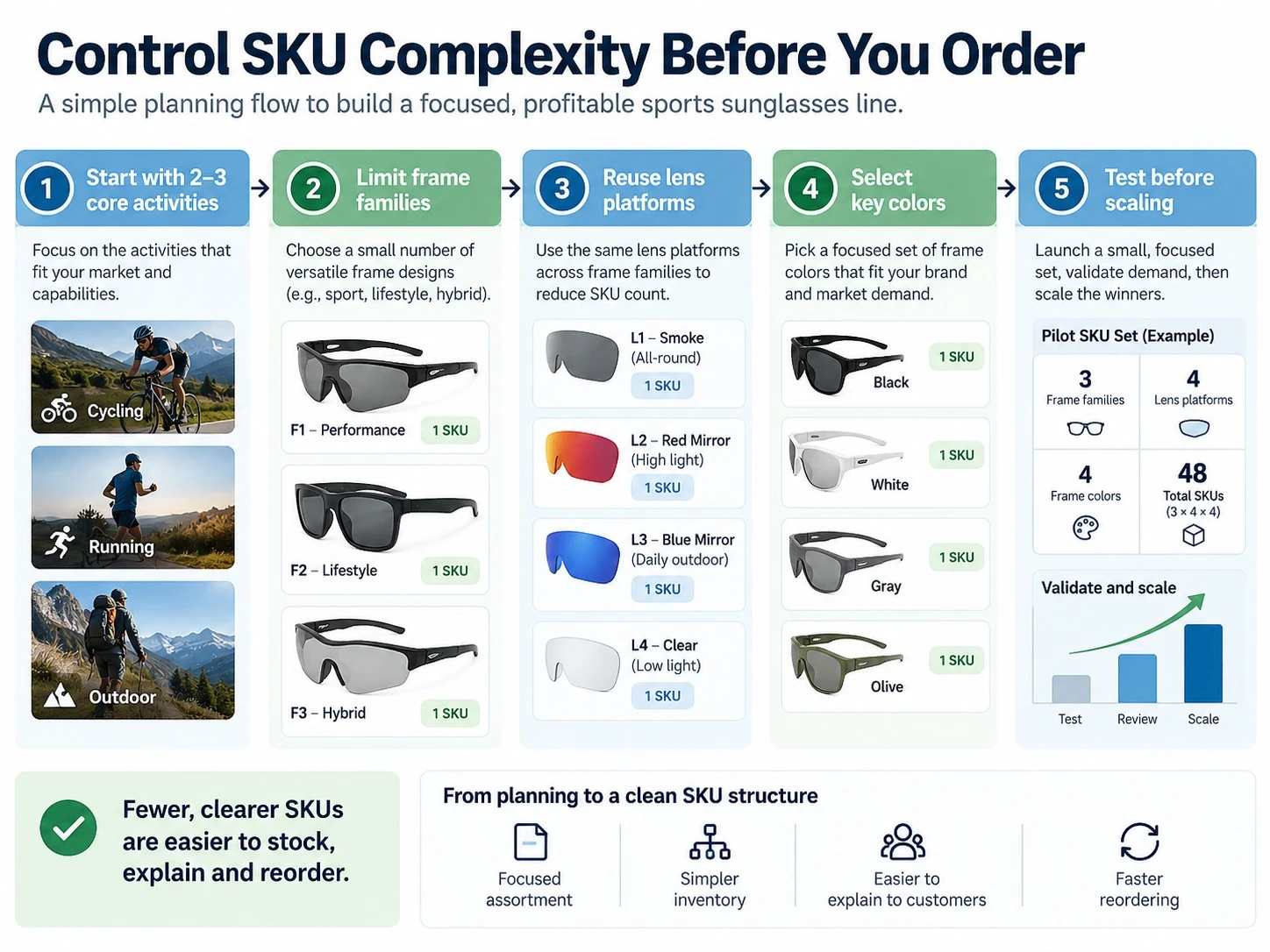
Control SKU Complexity Before You Place the Order
A sports sunglasses assortment can become complicated very quickly.
Consider only:
4 frames × 4 frame colors × 4 lens colors = 64 SKUs
Add two packaging options and the operational burden grows again.
More choice does not automatically create more sales.
It can instead produce:
fragmented order quantities,
slow-moving colors,
difficult replenishment,
higher inventory risk,
complicated photography,
and duplicated listings.
A better launch strategy is to create variation where the customer can perceive meaningful value.
For example:
Frame A – Running
Black / Smoke
White / Mirror
Frame B – Cycling
Black / Smoke
Black / Photochromic
Frame C – Fishing
Matte Black / Polarized Gray
Tortoise / Polarized Brown
Six clearly positioned SKUs may teach you more about the market than thirty speculative combinations.
Once sell-through data arrives, winning combinations can be expanded.
Use Color to Extend Winners, Not Rescue Weak Products
Color expansion is safest after the frame itself has proven demand.
If a sport frame performs poorly because the fit, coverage or positioning is wrong, introducing six additional colors rarely fixes the underlying problem.
First prove:
shape → fit → activity → price
Then expand:
frame color → lens color → finish
That order protects inventory.
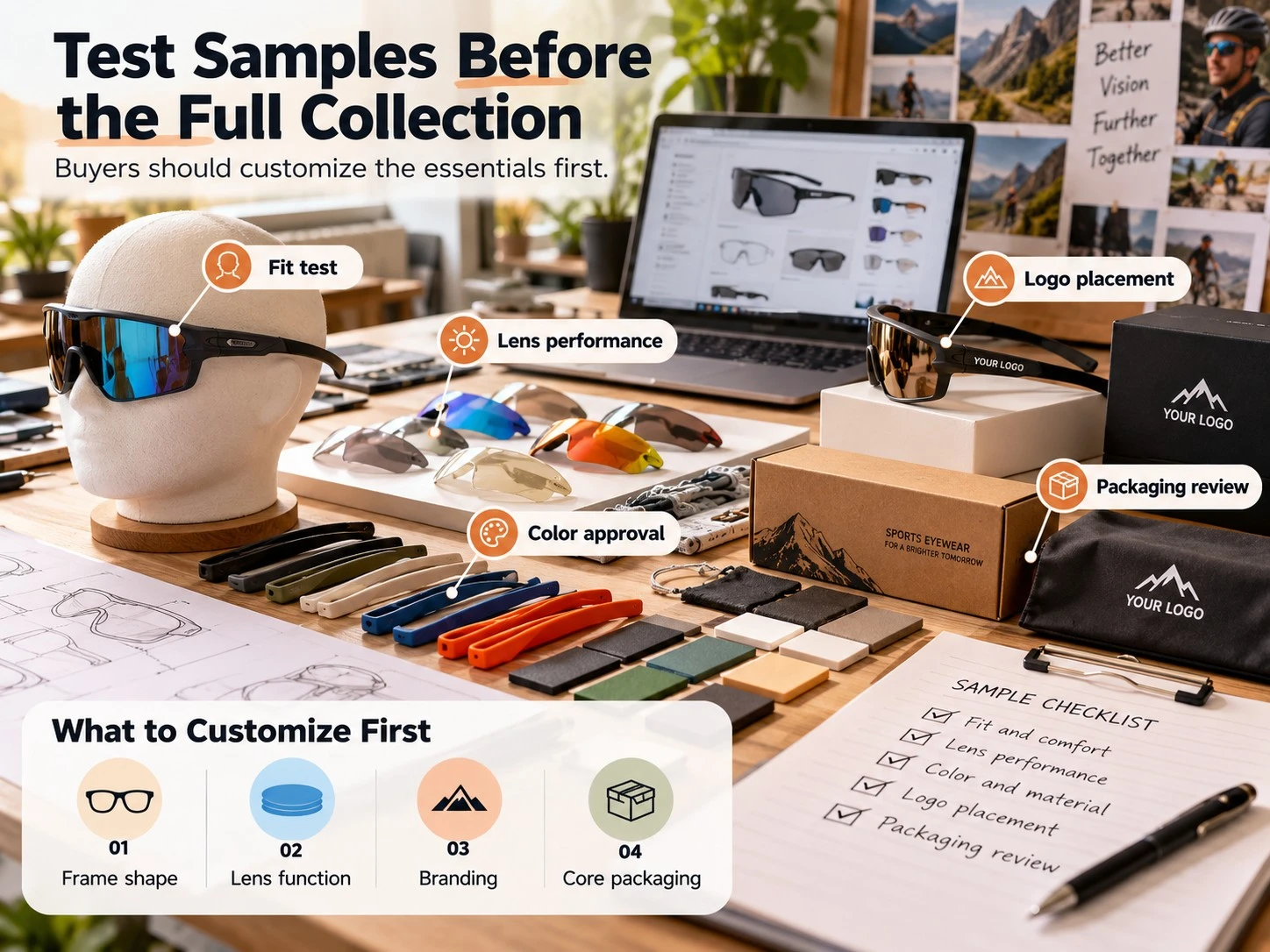
Test Samples Before Building the Full Collection
Catalog photos cannot tell you whether a sports frame works during movement.
Before approving a bulk order, request samples representing the actual specification as closely as possible.
Do not evaluate only appearance.
What Should Buyers Customize First?
Custom sports sunglasses can quickly become expensive if every component is changed simultaneously.
The smarter approach is to customize in the order that customers are most likely to notice and value.
1. Lens Specification
For sport eyewear, the lens usually changes the product proposition more than a logo does.
Decide first:
- standard tint,
- polarized,
- mirrored,
- photochromic,
- or another application-specific option.
2. Frame and Lens Color Combination
Use color to build recognizable brand language.
A black frame with smoke lens and the same frame with a bright mirror lens can serve two different customer profiles without redesigning the whole product.
3. Fit Components
If the existing platform allows it, evaluate nose pads, temple grip and fit details.
For genuine sport use, these can matter more than decorative trim.
4. Branding
Once the product specification is stable, add:
- printed logo,
- laser logo,
- temple branding,
- lens branding where appropriate,
- branded case,
- cleaning cloth,
- retail box,
instruction card.
5. New Tooling or Structural Changes
Start new tooling only when the business case justifies it.
Many private-label buyers do not need a completely new frame in their first collection.
Existing frame platforms combined with custom lens specifications, colors, logos and packaging can be a lower-risk way to test the market before investing in exclusive tooling.
For brands that already have proven demand, ODM development can then create a more differentiated second-generation product.
FAQ
What are the best sports sunglasses for a retail collection?
There is no single best model. Start with your target activities. A cycling range may prioritize coverage and ventilation; a running range may prioritize weight and retention; fishing eyewear may give greater importance to polarization and reflected glare. The strongest assortment normally contains fewer products with clearer purposes.
Should all sports sunglasses be polarized?
No. Polarization can be highly relevant for activities involving reflected glare, especially fishing and boating, but it does not need to be added automatically to every SKU. Use it where the customer can understand the benefit and where it supports the intended price position.
Are darker sports sunglasses better for UV protection?
Not necessarily. WHO specifically notes that UV-blocking performance cannot be determined from lens darkness or color. Verify the actual UV specification rather than assuming a dark or mirrored lens provides stronger UV protection.
How many sports sunglasses SKUs should I launch first?
There is no universal number. Start with enough SKUs to cover different use cases and price points without duplicating the same product. For a new collection, a small number of clearly differentiated frame-and-lens combinations can provide better sales information than a large color-heavy launch.
Should I use the same sunglasses for cycling, running and fishing?
One platform may work across several activities, but the product specification and merchandising should still reflect the actual use environment. Fishing may justify polarization, cycling may need greater coverage and airflow, while running may place more emphasis on lightweight stability.
Do ordinary sports sunglasses qualify as protective eyewear?
Not automatically. General sunglasses, specific sport protectors and occupational safety eyewear can fall under different standards and requirements. For example, ISO 12312-1 covers general-use sunglasses, ISO 18527-1 addresses downhill skiing and snowboarding goggles, and ASTM F803 covers protective eyewear for selected sports.
What information should I send a sports sunglasses manufacturer before requesting samples?
Provide your target sport, market, target retail price, expected quantity, preferred frame style, lens function, logo requirement, packaging and any required compliance target. A precise brief allows the supplier to recommend a relevant sample instead of sending random catalog models.
Conclusion: Build Around Use Cases, Not Catalog Size
A successful sports sunglasses collection does not need the largest number of frames.
It needs the clearest reasons to buy.
Start with the activity. Identify the light, movement, wind, reflection and wearing conditions. Choose the frame architecture that solves those problems. Then specify the lens, establish a clear Good-Better-Best price ladder and control unnecessary color combinations.
Only after the basic product has proven its role should you expand the SKU count.
For wholesale buyers and private-label brands, this also makes supplier communication much more efficient. Instead of asking for dozens of random sports sunglasses, you can build a sourcing brief around specific commercial positions:
Running / Entry
Cycling / Core
Fishing / Polarized
Performance / Premium
That gives every product a customer, a price position and a reason to exist.
Finewell Eyewear supports OEM, ODM and private-label sports eyewear development, including frame and lens colors, logo customization, lens options and branded packaging.
If you are planning a new wholesale sports sunglasses range, send us four details:
1. Target activity
2. Target retail price
3. Estimated order quantity
4. Required lens functions
We can then recommend three assortment directions-Entry, Core and Premium-so you can compare specifications before committing to a larger collection.
Explore our sport eyewear collection: /sport-eyewear/
Contact Finewell Eyewear for wholesale or private-label sports sunglasses development.


