

Wholesale Eyeglass Frames: How To Check Size, Lens Compatibility And Fit Before Ordering

Buying wholesale eyeglass frames involves more than choosing attractive designs. Before placing a bulk order, check five things: your target customers, frame measurements, prescription lens compatibility, wearing comfort, and production specifications.
A frame may look excellent in a supplier's catalog but create problems when an optical store tries to fit prescription lenses. Incorrect sizing, insufficient lens height, or unstable hinges can lead to fitting difficulties and customer returns.
This guide explains how eyewear retailers, wholesalers, and private-label brands can evaluate optical frames before committing to inventory.
Start With Your Target Customers and Prescription Lens Needs
The first question is not which frames are selling best. It is who will wear them and what lenses they need.
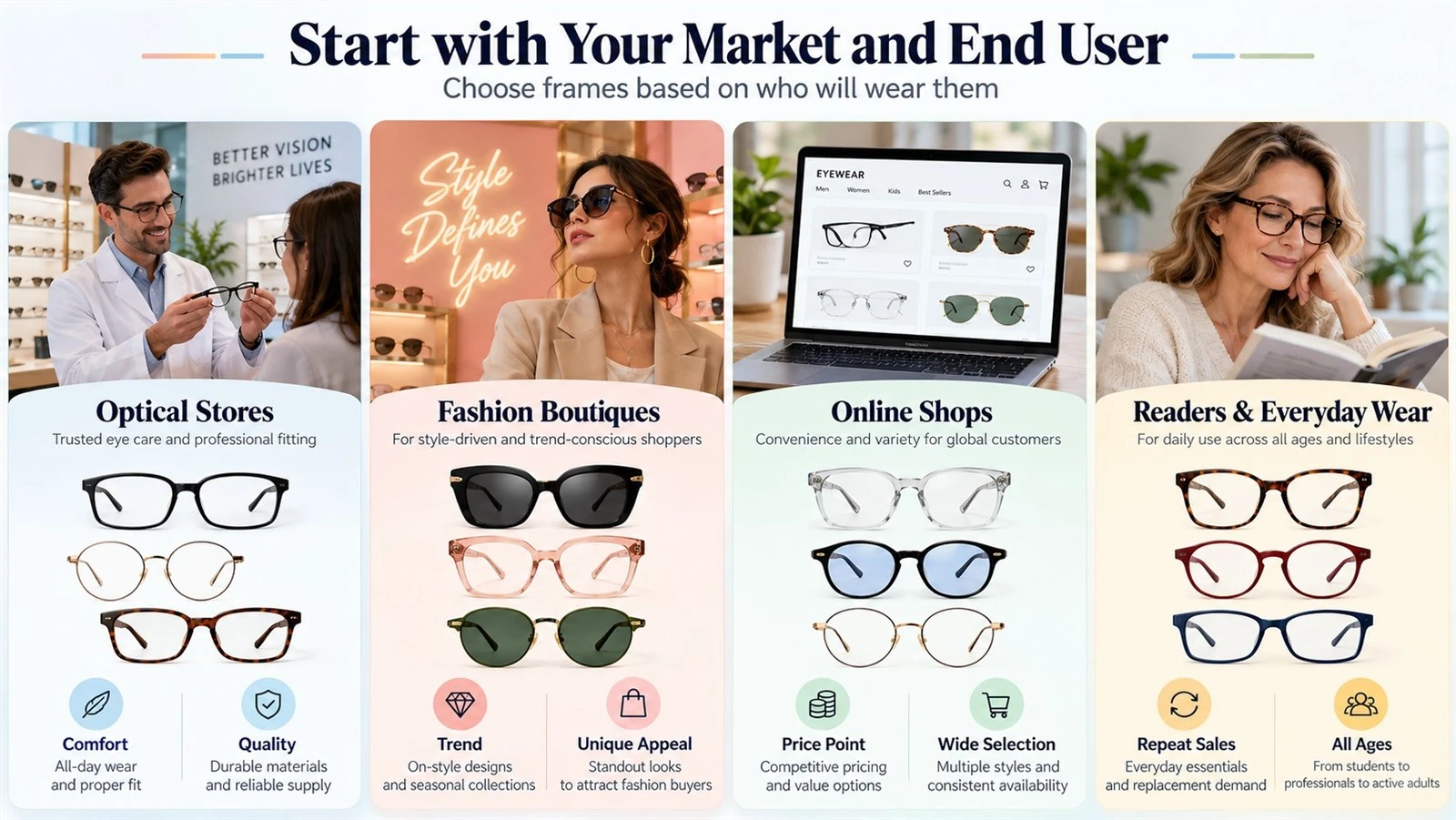
Identify Your Retail Market and End Users
Different retail channels have different purchasing priorities.
| Target customer | Frame priorities | Buying considerations |
|---|---|---|
| Independent optical stores | Fit, adjustability, prescription compatibility | Multiple sizes and reliable components |
| Fashion eyewear retailers | Design, colors, brand identity | Commercial shapes and seasonal collections |
| Online eyewear brands | Consistent measurements, clear specifications | Accurate sizing information and fewer fitting complaints |
| Premium optical boutiques | Material finish, comfort, detailing | Acetate quality, hinges and distinctive colors |
| Value-focused wholesalers | Practical designs, competitive costs | Repeatability, available stock and reorder options |
For example, a fashion boutique may successfully sell narrow rectangular frames with non-prescription lenses. An optical retailer serving progressive-lens wearers has different requirements.
The same frame does not necessarily suit both customers.
Decide What Lenses the Frames Must Accommodate
Before selecting wholesale optical frames, identify the intended lens applications:
- Single-vision prescription lenses
- Progressive and other multifocal lenses
- Reading glasses
- Prescription sunglasses
- Non-prescription fashion or demonstration lenses
A frame marketed as prescription-ready should be evaluated for its actual lens-mounting capabilities.
Ask your optical laboratory which lens designs, prescriptions, and materials can be fitted to the proposed frame. This prevents buying inventory that looks attractive but cannot serve your customers' prescription needs.
Understand Eyeglass Frame Measurements Before Ordering
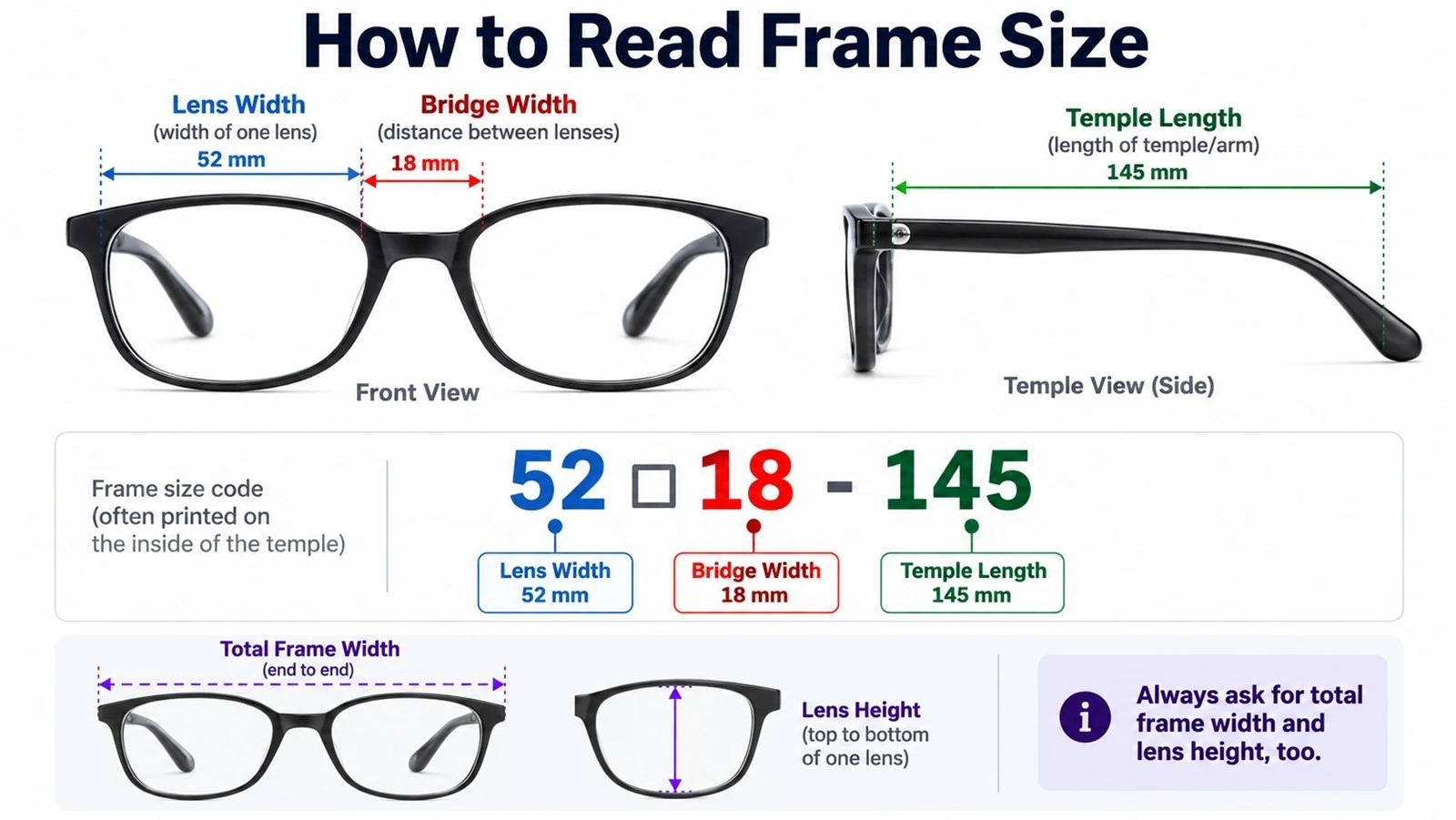
Most optical frames have three measurements printed inside the temple.
For example:
52 □ 18 – 145
These numbers describe the lens width, bridge size, and temple length in millimeters.
The measurement terminology used in the optical industry is covered by ISO 8624:2020, Ophthalmic optics - Spectacle frames - Measuring system and vocabulary.
What Do Lens Width, Bridge Width and Temple Length Mean?
| Measurement | Example | What it tells buyers |
|---|---|---|
| Lens width (A dimension) | 52 mm | Horizontal size of the lens opening |
| Bridge size (DBL) | 18 mm | Distance between the lens openings |
| Temple length | 145 mm | Nominal length of the temple |
| Lens height (B dimension) | 38 mm | Vertical size of the lens opening |
| Overall frame width | 138 mm | Approximate external width across the frame front |
Measurements are illustrative and do not describe a particular Finewell model.
These dimensions serve different purposes.
Lens width influences lens size, appearance, and prescription-lens thickness. Bridge construction affects how the frame sits on the nose, while temple length influences positioning around the ears.
However, two frames marked 52-18-145 can fit differently because of their bridge shape, hinge placement, frame curvature, and temple design.
Why Overall Frame Width and Lens Height Matter
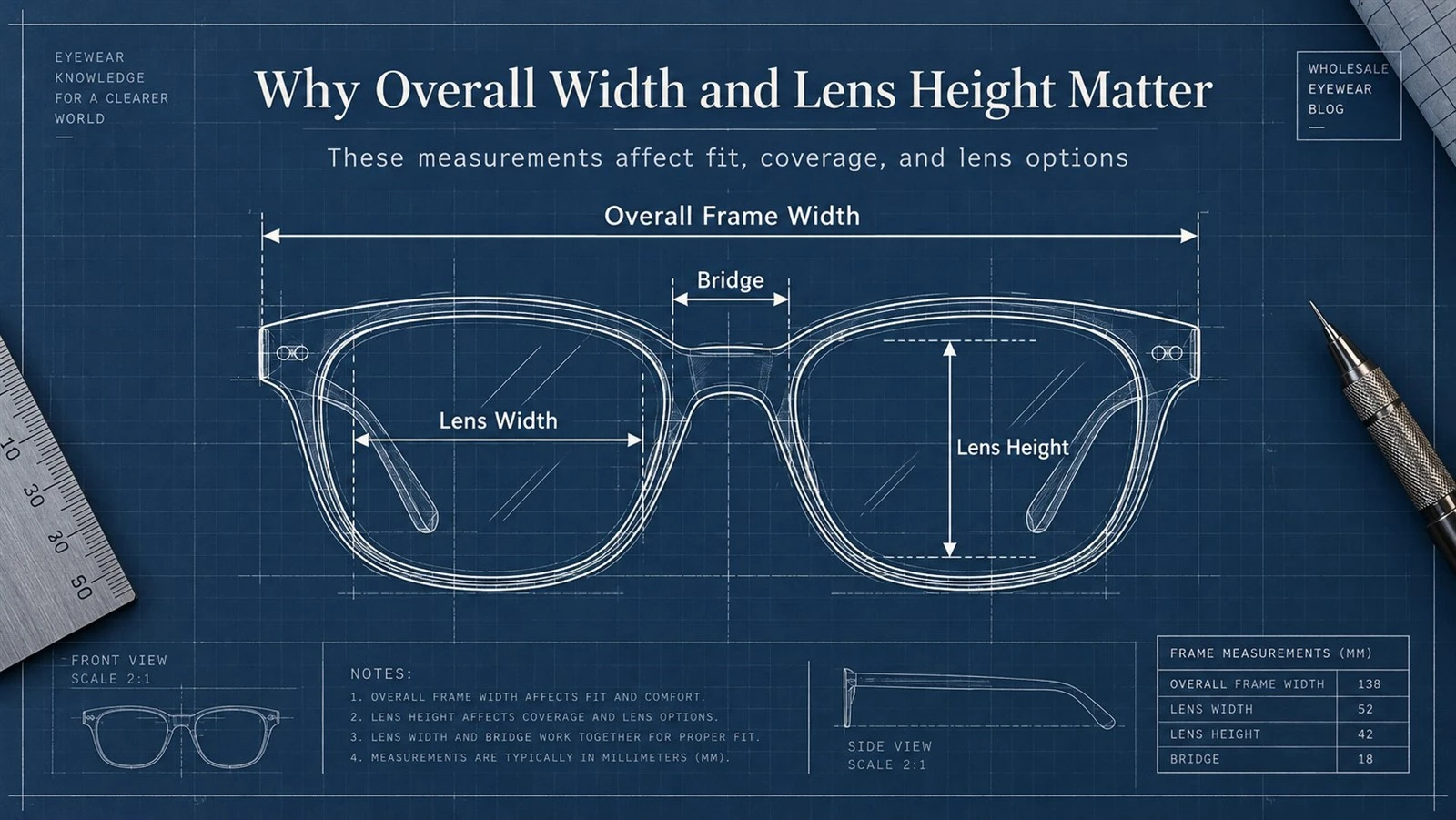
The printed three-number code does not tell you everything.
Overall frame width helps buyers evaluate whether the frame will fit narrow, average, or wider faces. It cannot be calculated accurately from the three-number code alone.
Lens height is particularly important for progressive lenses because these designs require sufficient usable vertical space for distance, intermediate, and near-vision zones.
For wholesale orders, request a complete dimension drawing showing lens width, bridge width, lens height, overall frame width, and temple length.
This is especially important for online retailers whose customers cannot try on frames before buying.
Check Prescription Lens Compatibility Before Choosing Frames
One of the most expensive sourcing mistakes is assuming that every optical frame can accept every prescription lens.
The frame structure, lens shape, mounting method, and prescription all influence whether a particular combination will work.
Full-Rim vs Semi-Rimless vs Rimless Frames
| Frame construction | Advantages | Prescription-lens considerations |
|---|---|---|
| Full-rim | Lens edges are supported by the surrounding rim | Check groove, bevel, thickness and lens retention |
| Semi-rimless | Lightweight appearance with an exposed lens edge | Usually requires suitable grooved lenses and retaining cord |
| Rimless | Minimalist appearance and reduced frame bulk | Requires compatible drill mounting and suitable lens materials |
Full-rim frames are often a practical starting point for general optical collections because the rim supports the lens perimeter.
Semi-rimless and rimless constructions demand closer coordination with the optical laboratory.
In particular, drilled mounting creates stresses around the mounting holes. Not every lens material or prescription is appropriate for every rimless design.
Buyer recommendation: Before approving a bulk order, send your laboratory a physical frame sample and confirm that the intended lens material can be safely processed and mounted.
How Frame Shape and Lens Size Affect Prescription Fitting
An attractive oversized frame may become less desirable when fitted with a strong prescription.
For minus lenses, larger lens dimensions and greater decentration can increase edge thickness. Plus lenses have different thickness characteristics, with center thickness being a major consideration.
The result depends on prescription power, lens material, shape, and optical-center placement.
Consider a frame with a 52 mm lens width and an 18 mm bridge.
Its nominal boxing-center distance is:
52 + 18 = 70 mm
If the customer's distance pupillary distance (PD) is 62 mm, symmetrical fitting would require approximately 4 mm of inward decentration per lens.
That adjustment affects the required lens blank size and potentially the finished thickness. Actual dispensing should use appropriate monocular measurements.
This is why frame PD must not be confused with the wearer's PD.
For buyers planning prescription eyewear collections:
Smaller, appropriately centered frames may help control thickness for stronger prescriptions.
Large frames should be evaluated carefully for high-powered lenses.
Very shallow frames require special attention when progressive lenses are intended.
Unusual lens shapes may create additional edging or mounting limitations.
There is no universal maximum prescription suitable for every frame. Final suitability must be confirmed by the dispensing professional and lens laboratory.
What Should Buyers Ask About Lens Materials and Coatings?
Frame suppliers and optical laboratories have different responsibilities.
A wholesale frame supplier should provide mounting dimensions, construction details, and information about the frame's intended applications.
The optical laboratory should confirm compatibility with materials such as CR-39, polycarbonate, Trivex, and high-index prescription lenses.
Ask these questions before ordering:
- Can the frame accommodate the intended prescription range?
- Is the mounting construction suitable for the chosen lens material?
- Does the design provide sufficient fitting height for the selected progressive lens?
- Are there restrictions on minimum lens thickness, edging, drilling, or grooving?
- Are the requested anti-reflective, scratch-resistant, photochromic, or other coatings available for the chosen lenses?
ZEISS, for example, offers progressive-lens designs with different fitting-height specifications. This demonstrates why lens compatibility must be assessed against the actual lens design rather than a generic claim that a frame is progressive-compatible.
A frame sample with demonstration lenses is not proof that the eventual prescription lenses satisfy these requirements.
Evaluate Wearing Fit, Comfort and Frame Balance
A frame that fits poorly in the showroom can create complaints after daily wear.
For wholesale buyers, comfort should be evaluated through physical samples, not catalog photographs alone.
Check the Nose Bridge, Temples and Hinges
Start with three contact areas.
Nose bridge: The frame should sit securely without excessive pressure or repeated slipping. Fixed acetate bridges and adjustable nose pads offer different fitting possibilities.
Temples: Check whether the temples follow the head comfortably without excessive side pressure. Examine the ear bend and temple-tip finish.
Hinges: Open and close both temples. Movement should be smooth and consistent, without unusual looseness or binding.
Examine Frame Symmetry and Balance
Place the sample on a level surface and examine it from the front and above.
Check for uneven temples, twisted frame fronts, poorly aligned hinges, and unstable lens rims.
Then evaluate the frame on actual wearers with different facial proportions.
Some adjustments can be made by trained opticians, but buyers should not rely on extensive adjustments to correct recurring production defects.
Compare Optical Frame Materials: Which Material Is Right for Your Retail Market?
Choosing between acetate, TR90, and metal optical frames is not simply a matter of appearance. Frame material influences how customers perceive your products, how comfortable they feel wearing them, how frames can be adjusted, and how much you may need to invest in production.
For wholesale buyers, the better question is not "Which material is the best?" but "Which material offers the right combination of appearance, comfort, cost, and selling points for my target customers?"
A fashion-focused optical boutique, an online eyewear brand, and a high-volume optical retailer may all benefit from different frame materials.
Understanding these differences helps you build a collection that customers can choose from for clear reasons, rather than stocking multiple frames that compete for the same buyer.
Acetate Frames: Choose Them When Design, Color and Perceived Value Drive Sales
Acetate is worth considering when your optical collection needs to stand out through frame design, distinctive colors, and a premium appearance.
Unlike many conventional injection-molded plastic frames, acetate frames are commonly produced by cutting and shaping material from sheets. This manufacturing process allows designers to work with layered colors, transparent effects, tortoiseshell patterns, and other distinctive finishes.
For retailers, this creates several commercial advantages.
1. More opportunities for product differentiation
If you sell through fashion boutiques, independent optical stores, or your own eyewear brand, distinctive acetate colors and patterns can help your collection look different from basic mass-market frames.
A thick rectangular acetate frame in a layered brown pattern, for example, can create a stronger visual identity than a similar frame in plain black plastic.
This is especially useful when customers are buying eyewear as a fashion accessory, not just a functional necessity.
2. Strong potential for premium retail positioning
Well-made acetate frames can communicate craftsmanship through their polished surfaces, material depth, and carefully finished edges.
These visible details may help retailers explain a higher selling price, particularly when combined with quality hinges, comfortable fitting, and thoughtful branding.
However, acetate alone does not make a frame premium. Poor polishing, uneven edges, or weak hinge installation can quickly undermine that positioning.
3. Useful for brands developing a recognizable collection
Acetate gives buyers a broad range of color and pattern options. Brands can create a consistent design identity through selected material sheets, frame shapes, and finishing details.
This can be valuable when you want customers to recognize your eyewear by its appearance rather than relying entirely on a visible logo.
What should buyers consider before ordering acetate frames?
Acetate frames may feel heavier than some lightweight TR90 designs, particularly when the frame front is thick. Production also involves multiple processing and finishing stages that can affect costs.
Some acetate frames allow controlled fitting adjustments by trained opticians using appropriate heating techniques, but adjustment must follow the specific frame construction and supplier guidance.
Before placing a wholesale order, check the polishing quality, material consistency, hinge installation, frame weight, and dimensional stability.
For buyers developing premium optical collections, explore Finewell's wholesale acetate frames to compare available shapes, colors, and customization options.
Best suited for: Independent optical boutiques, designer eyewear brands, fashion-oriented retailers, and collections where distinctive appearance supports the selling price.
TR90 Frames: Choose Them When Lightweight Comfort and Everyday Wear Are Priorities
TR90 can be a practical choice for optical retailers serving customers who wear glasses throughout the day and prioritize comfort over decorative frame details.
One of its main advantages is the ability to create lightweight, flexible frame designs. Depending on the construction, this can reduce the feeling of weight on the face and provide some flexibility during everyday handling.
For wholesale buyers, TR90 offers several reasons to consider it.
1. Comfort is an easy benefit for customers to understand
A lightweight frame has a clear selling point: customers can feel the difference when trying it on.
This can make TR90 attractive for everyday optical collections, particularly where customers prefer practical, comfortable eyewear for regular use.
However, a comfortable fit still depends on frame dimensions, weight distribution, bridge design, and temple pressure. Low weight alone does not guarantee comfort.
2. Suitable for functional, everyday optical collections
TR90 works well with many modern, understated frame designs.
If your customers prefer simple styling, flexible temples, and frames they can wear across different daily activities, TR90 can fit that product positioning.
It may be especially useful for retailers building an accessible everyday collection rather than a highly decorative fashion range.
3. Potential advantages for repeatable production
TR90 frames are commonly produced using injection-molding processes. Once a design and mold have been validated, this method can support consistent production of established shapes.
For wholesale programs with repeat orders, this can be useful.
However, buyers must also consider tooling requirements. Developing a completely new injection-molded frame can involve mold investment, while ordering an existing design may offer a more practical starting point.
What should buyers consider before ordering TR90 frames?
TR90 does not offer unlimited flexibility or adjustment.
Some frame constructions are not designed for conventional heat adjustments. Excessive bending or incorrect lens installation may damage the frame or affect its fit.
Buyers should ask the supplier about the adjustment method, hinge structure, prescription lens compatibility, and recommended lens installation process.
Pay particular attention to how securely the frame holds lenses after glazing and whether its shape remains stable during normal use.
Best suited for: Everyday optical retailers, comfort-focused eyewear collections, online brands offering lightweight designs, and wholesale programs built around practical, repeatable styles.
Metal Frames: Choose Them When Slim Design, Adjustable Fit and Versatility Matter
Metal frames offer a different value proposition from acetate and TR90.
While acetate often attracts attention through color and bold shapes, metal frames can appeal to customers who prefer slimmer profiles, subtle styling, and refined details.
For wholesale buyers, their value often comes from design versatility and fitting options.
1. Slim designs appeal to customers seeking understated eyewear
Metal construction allows manufacturers to create thin rims and delicate-looking frame structures.
This makes metal frames useful for classic round, oval, rectangular, and minimalist optical designs.
Such styles can fit into professional, classic, or premium fashion collections without depending on bold colors or thick frame fronts.
2. Adjustable nose pads provide additional fitting options
Many metal optical frames include adjustable nose pads.
For optical retailers with trained staff, this provides an opportunity to refine how the frame sits on the nose and how the lenses are positioned in front of the eyes.
This can be particularly useful when serving customers with different nose bridge shapes and fitting requirements.
However, not every metal frame has the same adjustment capabilities. The frame design, metal type, and joint construction all affect what adjustments are possible.
3. Different metal materials support different retail positions
Not all metal frames belong to the same price category.
Stainless steel frames can be suitable for collections prioritizing slim construction, strength, and a balanced cost.
Titanium frames may suit premium collections where low weight, corrosion resistance, and material quality are important selling points.
Other metal alloys can provide different combinations of appearance, flexibility, manufacturing cost, and surface finishes.
As a result, buyers should compare the actual metal specification rather than assuming every metal frame delivers the same performance.
What should buyers consider before ordering metal frames?
Quality control is especially important around welded or joined components, plating, hinges, nose-pad arms, and surface finishes.
Poorly finished joints may affect durability, while inadequate surface treatments can lead to discoloration or corrosion under certain conditions.
Buyers should also confirm relevant skin-contact material requirements for their target markets.
For prescription use, verify that the frame structure and adjustment process are suitable for the intended lenses.
Best suited for: Professional eyewear collections, classic optical retailers, minimalist fashion brands, and premium lines using materials such as titanium.
Acetate vs TR90 vs Metal: A Practical Comparison for Wholesale Buyers
| Buying consideration | Acetate | TR90 | Metal |
|---|---|---|---|
| Main customer appeal | Rich colors and distinctive design | Lightweight comfort and everyday practicality | Slim styling and fitting options |
| Typical retail positioning | Fashion and premium optical | Everyday and comfort-focused eyewear | Classic, professional or premium |
| Appearance | Layered colors, patterns and polished surfaces | Usually clean, molded designs | Thin profiles and metallic finishes |
| Weight | Often heavier in thicker designs | Generally lightweight | Varies significantly by metal and construction |
| Fitting adjustments | Some controlled heat adjustments | Often more limited; design-dependent | Frequently adjustable, especially with nose pads |
| Production considerations | Material sheets, cutting, polishing and assembly | Mold availability, tooling and dimensional consistency | Metal selection, forming, joints and finishing |
| Key quality checks | Surface finish, hinge installation, dimensions | Frame stability, lens retention, hinge durability | Joints, plating, nose pads and alignment |
| Best buying reason | Differentiate your collection through design | Offer a practical, comfort-focused product | Offer slim styling with suitable fitting options |
Actual price, durability, weight, and lens compatibility depend on the specific frame design, material grade, components, and manufacturing process. The table describes typical positioning, not guaranteed performance.
How Should Wholesale Buyers Choose Between These Materials?
Instead of choosing one material for your entire collection, consider what each material can contribute to your product range.
If your customers buy eyewear primarily for fashion, acetate may deserve more space in your assortment. Distinctive patterns, bold shapes, and polished finishes give shoppers visible reasons to choose one design over another.
If your customers prioritize comfort and practical daily use, consider TR90. Lightweight construction and understated styling can help you develop products that are easy to understand and sell based on everyday benefits.
If your customers prefer classic designs or need more fitting options, metal frames are worth considering. Slim profiles and adjustable nose pads can support a different set of customer preferences, while premium metals can create opportunities for higher-end collections.
You should also evaluate the commercial side of your selection. Ask your supplier about available molds, ready-made models, customization minimums, production costs, and lead times for each material.
For example, an existing TR90 frame may be a practical option for testing a new collection, while a distinctive acetate design may offer stronger brand differentiation. A titanium frame may serve a smaller premium customer segment rather than a price-sensitive, high-volume market.
Before committing to a large order, request samples representing the materials you plan to sell. Compare their appearance, weight, fitting comfort, hinge quality, and prescription lens compatibility using the same evaluation criteria.
The goal is not to find one material that does everything. It is to select frame materials that give different customers clear reasons to buy from your collection.
Confirm Customization, MOQ and Production Specifications
Choosing the right frame is only part of a successful purchase.
Buyers also need to know how much customization is possible and what changes will affect minimum order quantities, price, and production schedules.
Stock Frames vs Private Label vs Fully Custom Development
| Purchasing option | What can be changed | Best suited for |
|---|---|---|
| Stock wholesale frames | Existing models, available colors and quantities | Testing demand and fast assortment expansion |
| Private-label frames | Approved logos, packaging and selected finishes or colors | Launching a branded optical collection |
| Fully custom OEM/ODM | Frame geometry, materials, components and branding, subject to engineering approval | Developing differentiated or exclusive designs |
Stock models generally involve fewer development decisions.
Private-label orders allow buyers to establish brand identity without necessarily developing a new frame structure.
Fully custom development offers greater design control but may require new tooling, technical drawings, additional sampling, and longer lead times.
Finewell supports OEM and ODM eyewear customization, including frame colors, logo applications, and packaging.
Confirm MOQ, Color Assortments and Approved Specifications
A supplier's advertised MOQ does not always apply to every material, color, or customization method.
Before ordering, ask whether the quoted minimum applies per model, per color, or across the complete order.
Also confirm:
- Unit price at your target quantity
- Available stock and reorder conditions
- Logo method and placement
- Frame material and color codes
- Sample approval and production lead time
- Packaging, labeling and inspection requirements
For example, the cost structure of an order for a single color across four styles may differ from that of an order for a single style in only one color.
Request a quotation by model and color to avoid unexpected MOQ restrictions.
One important step: Approve a final pre-production sample before mass production. Keep that sample and its written specifications as references for production inspection.
This reduces the risk of receiving frames with different dimensions, colors, hinges, or branding from those originally approved.
Your Pre-Order Checklist for Wholesale Eyeglass Frames
Before paying a deposit, make sure you can answer these questions.
| Inspection item | What to verify |
|---|---|
| Target market | Who will wear the frames and where will they be sold? |
| Dimensions | Are the complete frame measurements available? |
| Lens compatibility | Has the optical laboratory approved the intended lens applications? |
| Fit | Have physical samples been tested for comfort and balance? |
| Materials | Are frame materials and component specifications confirmed? |
| Customization | Are colors, logos and packaging approved? |
| Bulk production | Are MOQ, pricing, lead time and QC criteria documented? |
Samples that pass the aforementioned inspections provide a more reliable scientific basis for procurement decisions than mere visual appearance.
Frequently Asked Questions About Wholesale Eyeglass Frames
1. What sizes should I choose for a wholesale eyeglass frame collection?
Start with the facial proportions and preferences of your target customers. A practical assortment can include narrower, medium, and wider frame options. Do not rely on lens width alone; compare complete front width, bridge shape, and temple length.
2. Can every optical frame be fitted with prescription lenses?
No. Prescription compatibility depends on lens shape, dimensions, mounting construction, lens material, and prescription power. Ask an optical laboratory to confirm compatibility before purchasing large quantities.
3. Are small eyeglass frames suitable for progressive lenses?
Some are, but lens height and fitting geometry are critical. Certain progressive designs accommodate relatively short fitting heights, while others require more space. Confirm the selected lens manufacturer's specifications and the wearer's measurements.
4. Which is better for wholesale optical frames: acetate or TR90?
Choose according to product positioning. Acetate is useful for rich colors and premium styling, while TR90 often suits lightweight, flexible designs. Neither material automatically guarantees better fit or durability.
5. What is the MOQ for custom eyeglass frames?
MOQ depends on frame material, model availability, color requirements, branding method, and development complexity. Existing stock models may support smaller orders than fully customized designs. Request model-specific pricing rather than assuming one MOQ applies to every frame.
Conclusion: Choose Optical Frames That Work Beyond the Display Shelf
Successful wholesale eyeglass frame sourcing is not simply about identifying the most attractive styles.
A commercially useful frame must suit the intended customer, accommodate the required lenses, fit comfortably, and remain consistent across repeat production orders.
By checking measurements, lens compatibility, materials, and manufacturing specifications before purchasing, buyers can reduce avoidable fitting problems and build collections that optical retailers can confidently sell.
Build Your Next Optical Collection With Finewell Eyewear
Finewell Eyewear supplies wholesale optical frames and supports OEM, ODM, and private-label eyewear projects.
Whether you are testing a new collection or expanding an established brand, our team can help you compare available designs, materials, customization requirements, and purchasing options.
Contact us for three sourcing options:
- Stock Wholesale: Existing models for testing your market.
- Private Label: Selected frames with customized logos and packaging.
- Custom OEM/ODM: Frame development based on your design specifications.
Send us your target market, preferred frame styles, required sizes, estimated quantity, and customization requirements.
Contact Finewell Eyewear for a catalog, samples and quotation.
No Information


