

Custom Eyewear Packaging Options For Private Label Brands
Custom eyewear packaging should be selected according to the size, shape and sales channel of the eyewear-not simply by choosing the most attractive box. A suitable package must protect the frame, control shipping volume, support the correct logo process and present the product at the right retail price point.
For private label brands, packaging decisions therefore affect more than appearance. They influence freight cost, product damage, customer reviews, retail positioning and the speed at which an order can enter production.
A compact optical frame, an oversized fashion sunglass and a curved sports frame should not automatically use the same case. Before approving any packaging, the supplier should confirm what will be placed inside it, the folded dimensions of the eyewear and how the finished product will be shipped.
Why Eyewear Packaging Is More Than a Branded Box
While a logo certainly identifies a brand, it cannot compensate for packaging-related shortcomings such as insufficient commercial value, inadequate size or strength, or excessive bulkiness.
Good eyewear packaging performs four jobs at the same time.
Supporting the commercial value of the brand
When building a private label eyewear brand, the unboxing experience directly correlates with customer retention and perceived value. You are not just selling UV400 protection or blue-light blocking lenses; you are selling an aesthetic.
Consider the reality of retail returns. Are you frequently dealing with complaints about bent temples or crushed frames? Oftentimes, the culprit is not the manufacturing of the frame, but inadequate packaging that failed to withstand the pressure of shipping and handling. Proper rigid packaging eliminates these costly post-sale headaches.
Furthermore, data consistently proves the commercial value of premium packaging. According to an Ipsos standard consumer study, 72% of consumers state that packaging design directly influences their purchasing decisions. Similarly, a comprehensive e-commerce packaging report by Dotcom Distribution found that over 40% of online shoppers are more likely to make repeat purchases from a merchant that delivers orders in premium packaging.
It protects the actual frame geometry
Eyewear is not a flat product. The front width, lens curvature, temple thickness, hinge position and folded height all affect how much internal space is required.
A slim metal optical frame may fit comfortably inside a compact case. An oversized acetate sunglass may require more front width and depth. A wraparound sports frame may need additional internal height because the curved lens prevents the temples from folding completely flat.
When these differences are ignored, the temples may be forced against the lenses, the bridge may press against the case wall, or the zipper may place pressure on the frame.
The result is not only a damaged package. It can also create scratched lenses, deformed temples or loose alignment before the consumer opens the product.
It affects freight and storage cost
Packaging cost is not limited to the unit price of the case.
A case that is several centimetres larger than necessary occupies more space in the export carton, warehouse and retail display. Across a bulk order, this can increase carton quantity and chargeable shipping volume without adding protection.
The correct conclusion is simple: the smallest package that safely fits the eyewear is usually more commercially efficient than the largest available case.
It forms part of the complete supply chain
Retail packaging may pass through factory packing, export cartons, warehouses, fulfilment centres, couriers and finally the consumer.
ISTA notes that packaged products in e-commerce supply chains can face vibration, shock, compression, temperature and humidity hazards. This means packaging should be reviewed as a product-and-package system, not as a decorative item by itself.
Main Custom Eyewear Packaging Options

Private label eyewear packaging can range from a simple pouch to a complete multi-piece presentation set.
| Packaging option | Best suited for | Protection level | Common branding methods | Main purchasing consideration |
|---|---|---|---|---|
| Microfiber pouch | Promotional sunglasses, reading glasses, low-cost collections | Basic scratch protection | Silk printing, heat transfer | Low weight, but limited crush protection |
| Foldable triangle case | Fashion sunglasses, travel retail, online orders | Medium | Silk printing, embossing, hot stamping | Saves storage space before assembly |
| Hard-shell eyeglass case | Optical frames, sunglasses, premium collections | High | Silk printing, embossing, hot stamping, metal plate | Dimensions must match the folded frame |
| PU or leather-look case | Boutique and premium private label collections | Medium to high | Embossing, debossing, foil stamping, metal badge | Surface texture affects logo clarity |
| Paperboard box | Entry-level retail, gift sets, outer packaging | Depends on internal insert | Silk printing, offset printing, foil stamping | Paper thickness and insert design matter |
| Rigid gift box | Premium eyewear, influencer kits, limited editions | High when fitted with an insert | Printing, foil stamping, spot UV, embossing | Higher MOQ and shipping volume |
| Zipper case | Sports eyewear, cycling glasses, safety eyewear | High | Rubber badge, woven label, printing, embossing | Must allow for lens curvature and accessories |
| Multi-piece packaging set | Established brands and complete retail presentations | High | Coordinated logo applications | Every component should be specified separately |
Finewell's eyeglasses case collection includes options for different frame shapes, retail levels and branding requirements. The site also lists hard-shell cases, larger sunglass cases and luxury eyewear packaging formats.
Finewell's frequently selected four-piece packaging solution
Many Finewell customers choose a four-piece packaging set built around a protective case. It gives the buyer a coordinated retail presentation rather than sourcing the case, cleaning accessory and outer packaging from several different suppliers.
The hard-shell eyeglass case is a common starting point because it offers stronger protection than a soft pouch alone.
How to Match Packaging with Your Eyewear Collection
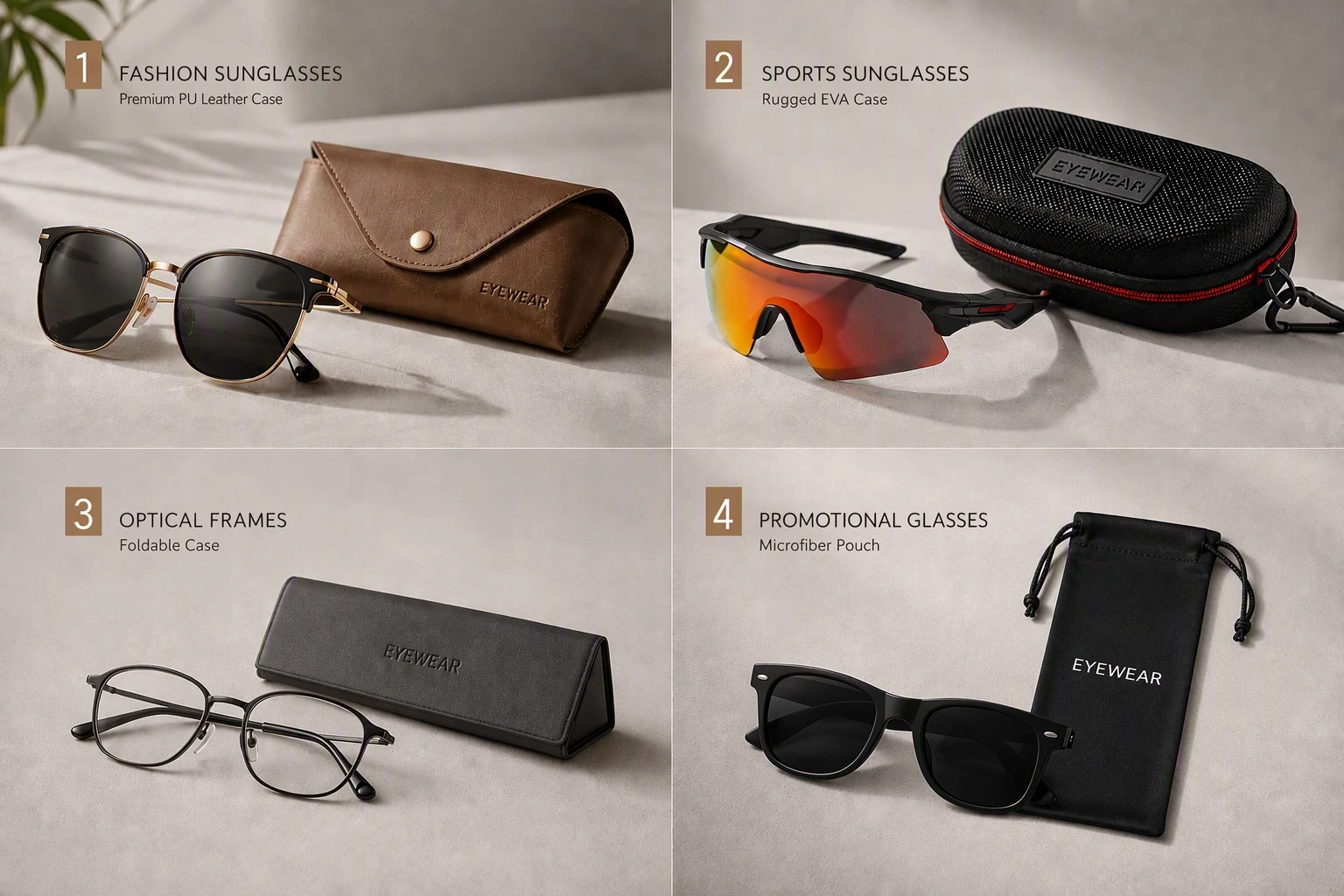
At Finewell, packaging recommendations normally begin with one question:
What type of eyewear will be placed inside the package?
Without this information, even an attractive package can become the wrong purchase.
Optical eyewear usually needs a more compact case
Optical frames are often smaller and flatter when folded than oversized sunglasses. A compact case can therefore provide sufficient protection while reducing carton volume.
The interior should still prevent the lenses from touching exposed metal, rough seams or hard internal edges. This is especially important for clear lenses, where a small scratch is more visible than it may be on a dark sunglass lens.
Buyers developing prescription or blue-light collections can review Finewell's optical eyewear range before confirming the packaging format.
Fashion sunglasses may need additional width and height
Oversized acetate frames, thick temples and large cat-eye designs frequently require a larger case than standard optical eyewear.
Do not evaluate the case using front width alone. The supplier should check:
Total frame width
Lens and front height
Folded temple position
Maximum folded thickness
Bridge projection
Decorative parts or metal details
A case that closes only when pressure is applied is too small, even if the eyewear can technically be placed inside it.
Brands building a fashion collection can match packaging against specific products in the Finewell sunglasses collection.
Sports and safety eyewear often need zipper cases
Sports and safety frames are commonly more curved than fashion sunglasses. Some products also include interchangeable lenses, straps, cleaning cloths or prescription inserts.
A zipper case can provide more internal space and better coverage for these structures. The internal shape should support the lens curve rather than forcing the frame flat.
This is why Finewell generally recommends zipper cases for many products in its sports eyewear collection.
The commercial benefit is lower after-sales risk. When the case follows the frame geometry, the product is less likely to arrive with pressure marks, bent temples or damaged accessories.
What Can Be Customized?
Custom eyewear packaging can involve much more than adding a logo.
Case size and internal dimensions
The outer dimensions affect freight and presentation. The internal dimensions determine whether the eyewear can be stored safely.
For a new project, provide the supplier with either:
- A physical eyewear sample
- A confirmed production sample
- A technical drawing
- Accurate folded dimensions
- Clear photographs showing the frame from several angles
The package should ideally be tested with the actual production frame rather than a vaguely similar model.
Surface material and finish
Depending on the packaging type, buyers may select:
- PU surfaces
- Fabric coverings
- Flocked or plush materials
- Paperboard
- Kraft paper
- Molded plastic
- EVA shells
- Metal shells
- Matte or glossy lamination
- Textured paper
- Soft-touch finishes
Material choice determines not only appearance but also which logo methods are technically suitable.
Retail information
The outer package may also carry:
- Product model
- Barcode
- SKU
- Country-of-origin information
- Material information
- Care instructions
- Lens information
- Compliance markings where applicable
- Recycling or disposal information
These details should be planned before mass production, particularly when the same eyewear will be sold in several markets.
Logo, Color and Material Selection
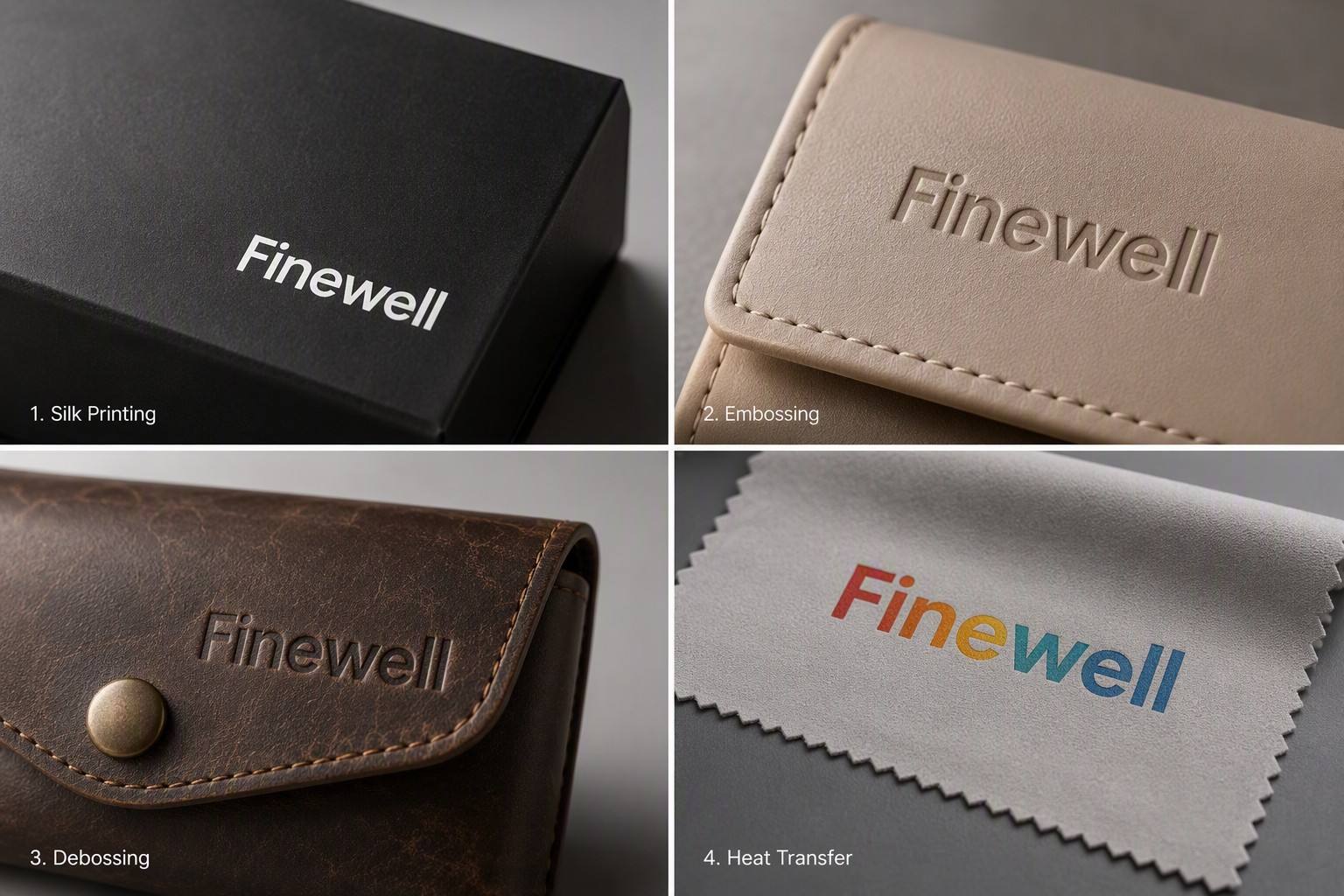
One of the most expensive packaging mistakes is confirming the logo effect before confirming the packaging material.
The correct sequence is:
- Select the packaging structure.
- Confirm the surface material.
- Review compatible logo processes.
- Approve the logo size and position.
- Produce a physical sample.
Plush or flocked surfaces
For plush or flocked eyewear packaging, debossing normally produces the cleanest result.
Silk printing is often a poor choice because the ink sits on an uneven surface. The logo may lack sharp edges, and the printed layer can wear or peel, damaging the appearance of the package.
The conclusion is not that silk printing is an inferior process. It is simply incompatible with some surfaces.
Hard paper boxes
For many hard paper boxes, printing is a practical choice because it can produce a clean logo with a relatively straightforward production process.
Debossing can create a more premium effect, but it may need to be completed while the packaging is still in a semi-finished stage. This changes the production sequence and can increase lead time.
A buyer who confirms debossing after the finished boxes have already been assembled may discover that the requested process is no longer practical.
PU and leather-look cases
Debossed logos can create a subtle premium appearance on suitable PU surfaces. Foil stamping can add stronger visual contrast, while a metal badge may support a higher-end collection.
However, deep textures, curved surfaces and seams can reduce logo clarity. A physical sample is more reliable than judging the result from a digital mock-up.
Color approval
Packaging color can be approved through:
- Pantone references
- Supplier color cards
- Printed proofs
- Material swatches
- Physical reference samples
Pantone codes are useful, but they do not guarantee that paper, PU, fabric and metal will look identical. Different materials reflect light differently.
For a multi-piece set, approve the components together. Otherwise, a "black" case, pouch and outer box may arrive in three visibly different shades.
What to Send Your Finewell Eyewear
To eliminate back-and-forth communication delays on WhatsApp or email, prepare a complete technical package for your supplier before asking for a quote. Ensure you provide:
- Vector Art Files: Your logo in .ai, .eps, or .pdf format. JPEGs and PNGs cannot be used for high-quality printing molds.
- Pantone Codes: Specific Solid Coated Pantone (PMS) numbers for your brand colors to ensure absolute color consistency across different materials.
- Frame Dimensions: The exact L x W x H in millimeters of the frames that will go inside, or a physical sample of the frame sent to Finewell Eyewear via DHL/FedEx.
FAQ About Custom Eyewear Packaging
What is the best packaging for a private label eyewear brand?
There is no single best option.
A hard-shell case is a practical choice for optical frames and premium sunglasses. A zipper case is often more suitable for curved sports or safety eyewear. A pouch may be sufficient for promotional products when the outer shipping carton provides additional protection.
The best package is the one that matches the eyewear structure, retail price and delivery channel.
Should I select the eyewear or packaging first?
Confirm the eyewear model first.
The frame dimensions, folded thickness and lens curvature determine the minimum internal size of the package. Packaging selected before the product may need to be replaced later.
Can one case be used for an entire collection?
Yes, provided that every model fits safely.
Test the case with the largest, tallest and most curved frame in the collection. Do not approve it using only the smallest model.
If several products have substantially different dimensions, using two case sizes may reduce damage and shipping waste.
Can I mix different colors of packaging within one MOQ order?
Usually, yes, but with limitations. For example, if the minimum order quantity for your preferred custom PU leather glasses case is 1,000 units, we generally allow the order to be split between two colors (e.g., 500 black and 500 brown), provided that the logo mold and the physical shape of the case remain identical.
How much does packaging add to international shipping costs?
It depends entirely on the volume. Shipping 1,000 rigid hard cases by air freight takes up significant CBM (Cubic Meters) because you are essentially paying to ship empty air. This is why foldable PU cases have become incredibly popular for cross-border B2B buyers; they ship flat, dramatically reducing dimensional weight charges.
Conclusion-Choose Packaging Based on the Complete Supply Chain
Custom eyewear packaging should begin with the product, not with the logo.
First confirm the eyewear type, dimensions and folded shape. Then select the case structure, material and internal protection. Only after the surface material is approved should the logo process be finalized.
This sequence prevents three common B2B purchasing problems:
- The eyewear does not fit the package.
- The package is larger than necessary and increases freight cost.
- The approved logo process is incompatible with the selected material.
For optical frames, a compact hard case may provide the right balance of protection and shipping efficiency. Oversized sunglasses may need more width and internal height. Sports and safety eyewear generally require a case that accommodates lens curvature and additional accessories.
Finewell can help you compare a simple private label package, a coordinated four-piece set and a fully customized packaging solution according to your collection, MOQ and target market.
Send your eyewear models, quantities and logo artwork through the Finewell inquiry form to receive packaging recommendations and multiple quotation options based on your complete supply chain.
No Information


