

Custom Sunglasses With Logo: 5 Logo Methods Compared By MOQ, Cost & Lead Time

Custom sunglasses with logo can be branded using five main methods: laser engraving, laser engraving with paint filling, screen printing, hot stamping, and 3D metal logos. Each offers a different appearance, minimum order quantity (MOQ), cost structure, and production timeline.
For small orders, laser engraving is generally the simplest option, starting from 20 pairs. Screen printing works well for colored logos, while hot stamping creates a metallic finish. Acetate sunglasses can use paint-filled engraving for a more distinctive look. For premium eyewear collections, 3D metal logos provide a separate physical brand element but require higher order quantities.
The right choice depends on your frame material, logo design, order volume, and target retail market.
1. Five Logo Customization Methods for Sunglasses
1.1 Laser Engraving - Best for Small Orders and Minimalist Branding
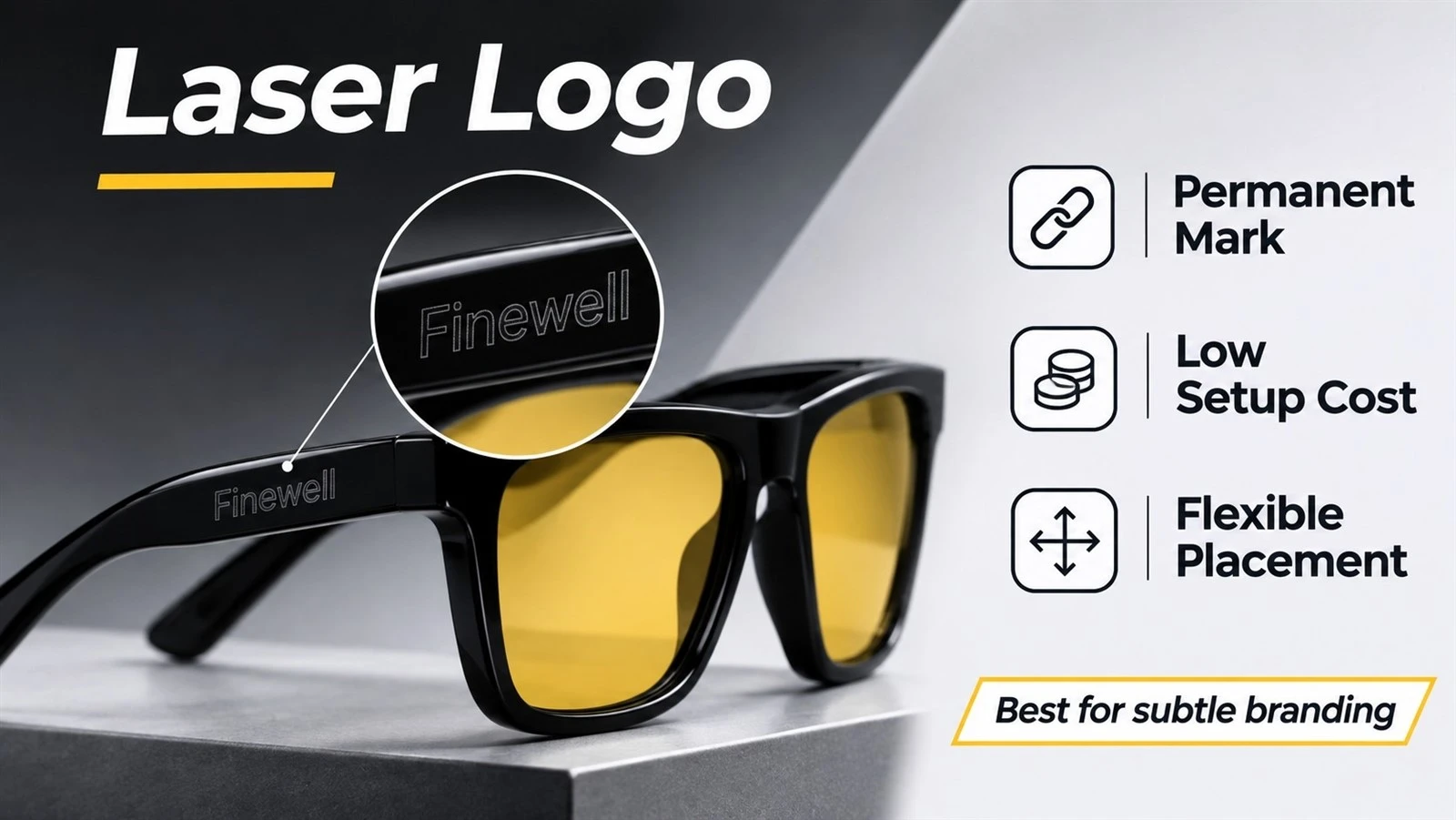
Laser engraving uses a controlled laser beam to mark a logo directly onto a suitable eyewear surface without adding ink or a separate metal component.
It works across a wide range of eyewear materials, including acetate, PC, TR90, and metal, provided the material and finish are compatible with the selected laser process.
Best applications:
Inside or outside of temples
Suitable frame fronts and metal components
Selected lens-edge areas after technical approval
Laser engraving is particularly useful for new eyewear brands testing their first collection.
For example, a retailer ordering 20 pairs of sunglasses can add a discreet logo to existing frames without investing in a metal logo mold.
Advantages: Low MOQ, straightforward setup, and a clean appearance.
Limitations: Engraved contrast varies by material and color. Laser marking also requires careful process selection to avoid damaging coatings or sensitive lens surfaces.
1.2 Laser Engraving With Paint Filling - Best for Acetate Sunglasses
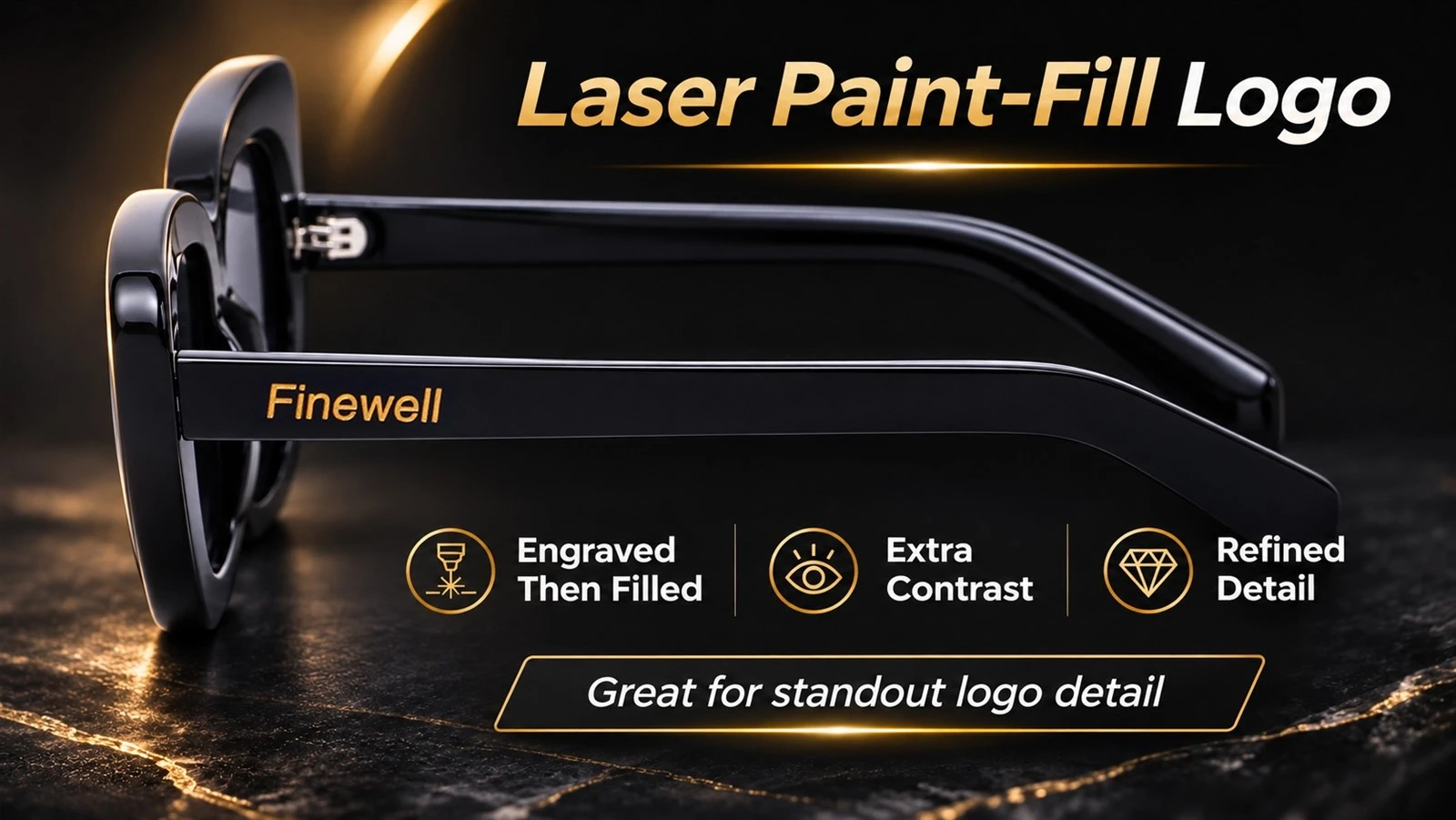
Laser engraving with paint filling combines two processes. First, the logo is engraved into an acetate frame. Next, colored paint is applied to the engraved area and finished to create a contrasting design.
Unlike ordinary laser engraving, this technique allows the brand name or symbol to stand out in a selected color.
At Finewell, this method is offered for acetate eyewear frames only, not lenses.
Consider a black acetate sunglass frame with a recessed white logo on the temple. The contrasting finish makes the branding visible without requiring a separate decorative emblem.
Advantages: Custom logo colors, defined lettering, and a refined appearance for acetate collections.
Limitations: Additional filling and finishing operations increase processing time. Very fine lettering may need adjustment to achieve a consistent result.
For premium acetate sunglasses, this is a practical alternative to attaching a separate metal badge.
1.3 Screen Printing - Best for Colored Logos and Promotional Sunglasses
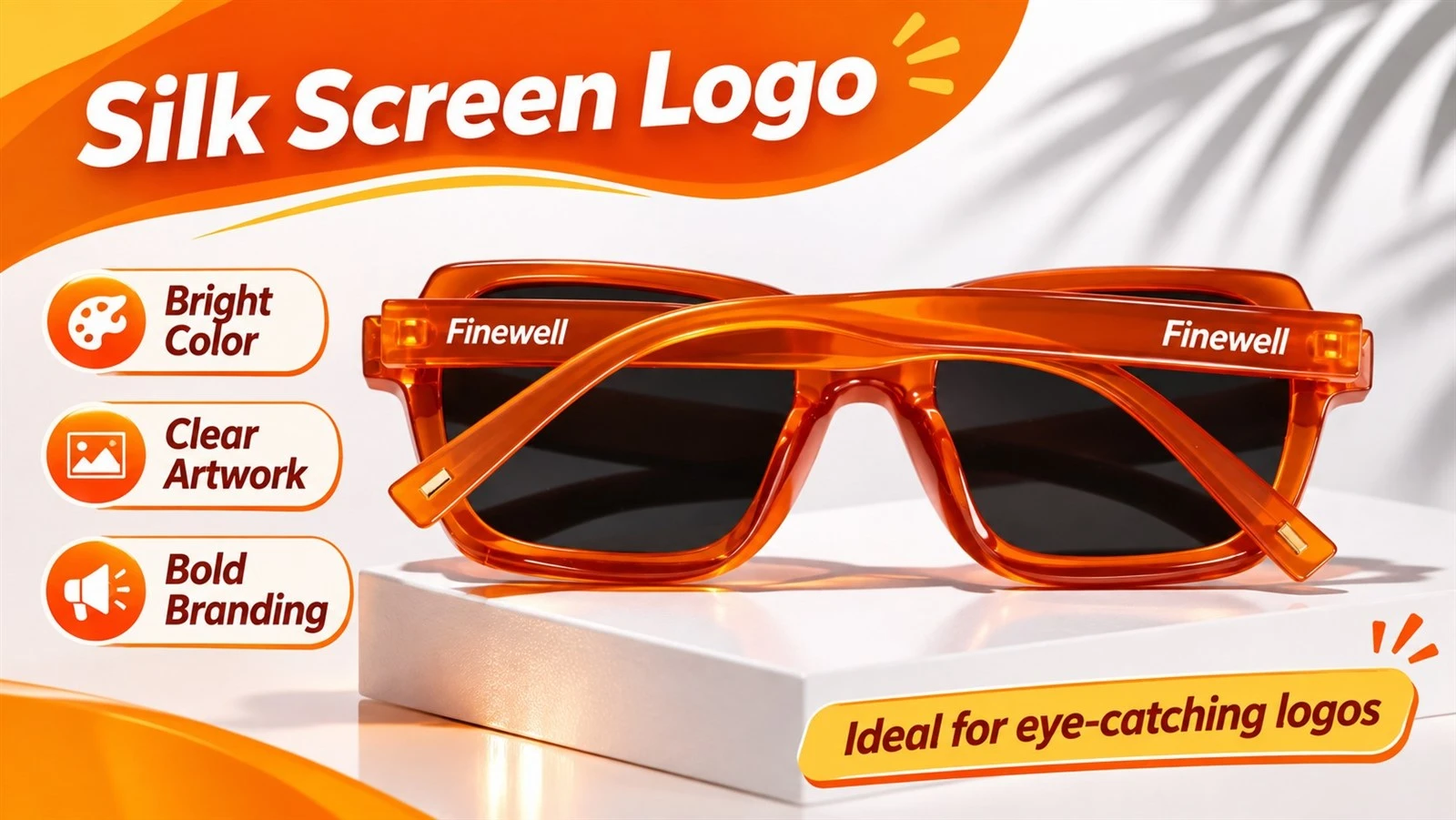
Screen printing transfers ink through a prepared screen onto the selected eyewear surface.
It is suitable for various eyewear products, including plastic, acetate, metal, and compatible lens surfaces. However, ink formulation must match the substrate and its coating.
Screen printing is particularly useful when a brand requires a recognizable color rather than a plain engraved mark.
For example, a sports retailer may want a white logo on black temples, while a promotional sunglasses distributor may require a bright corporate color.
The main variables are ink color, logo dimensions, printing position, and the number of printed locations.
Advantages: Colored branding, repeatable designs, and good suitability for promotional collections.
Limitations: Screens and ink preparation require setup. Multiple colors or difficult curved surfaces can increase production complexity.
1.4 Hot Stamping - Best for Gold, Silver, and Metallic Branding
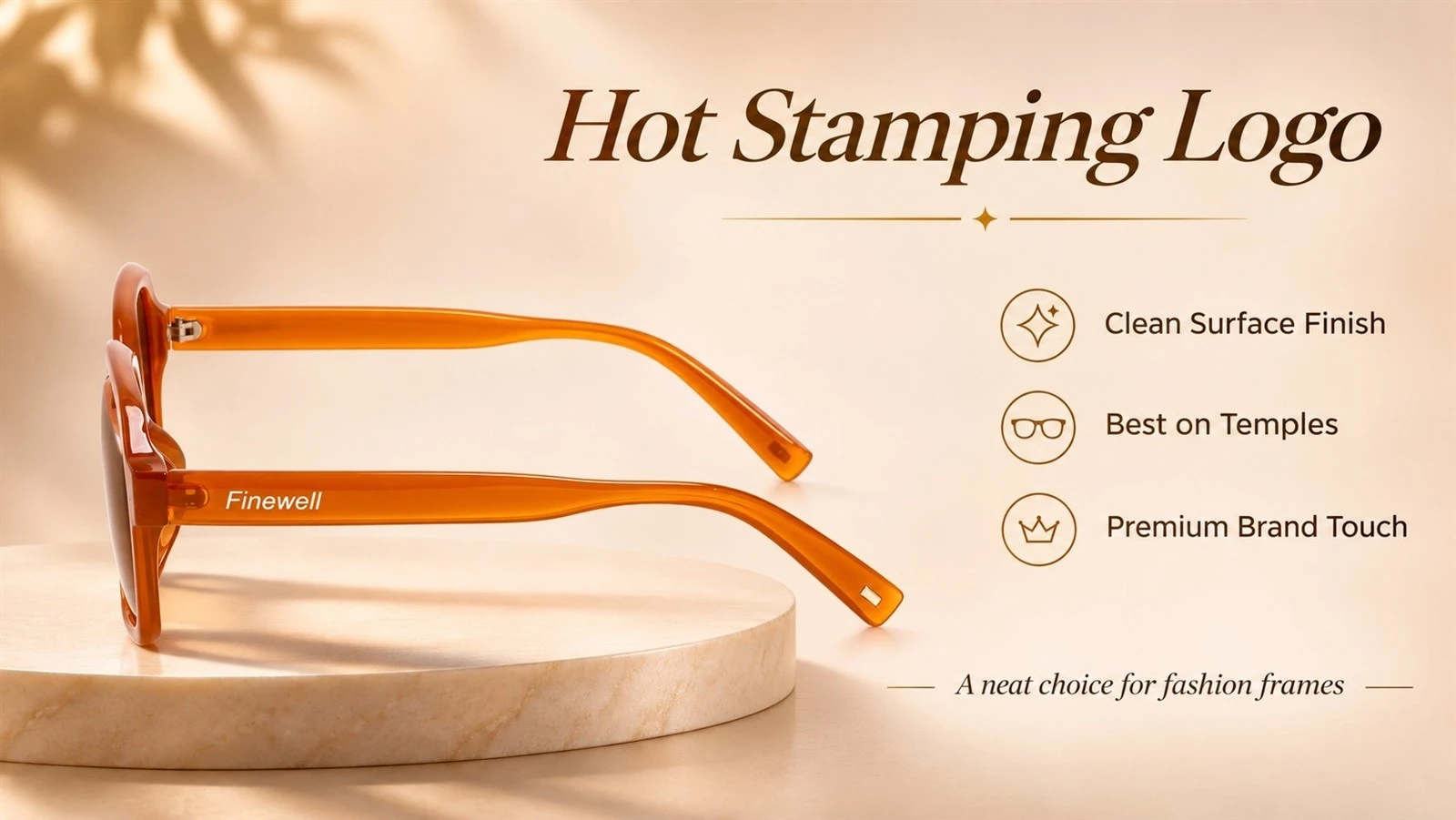
Hot stamping applies a decorative foil to an eyewear frame using controlled heat and pressure.
It is available for suitable frame materials and surfaces, but Finewell applies this method to frames only, not lenses.
Gold and silver are common choices for private label sunglasses, particularly for boutique and fashion-oriented collections.
A small gold logo on a tortoiseshell acetate temple, for example, can create a different retail impression from the same frame carrying a standard printed logo.
Advantages: Metallic appearance, precise branding, and no separate metal emblem.
Limitations: Tooling, surface curvature, foil selection, and processing conditions affect consistency. Complex or uneven surfaces may require additional evaluation.
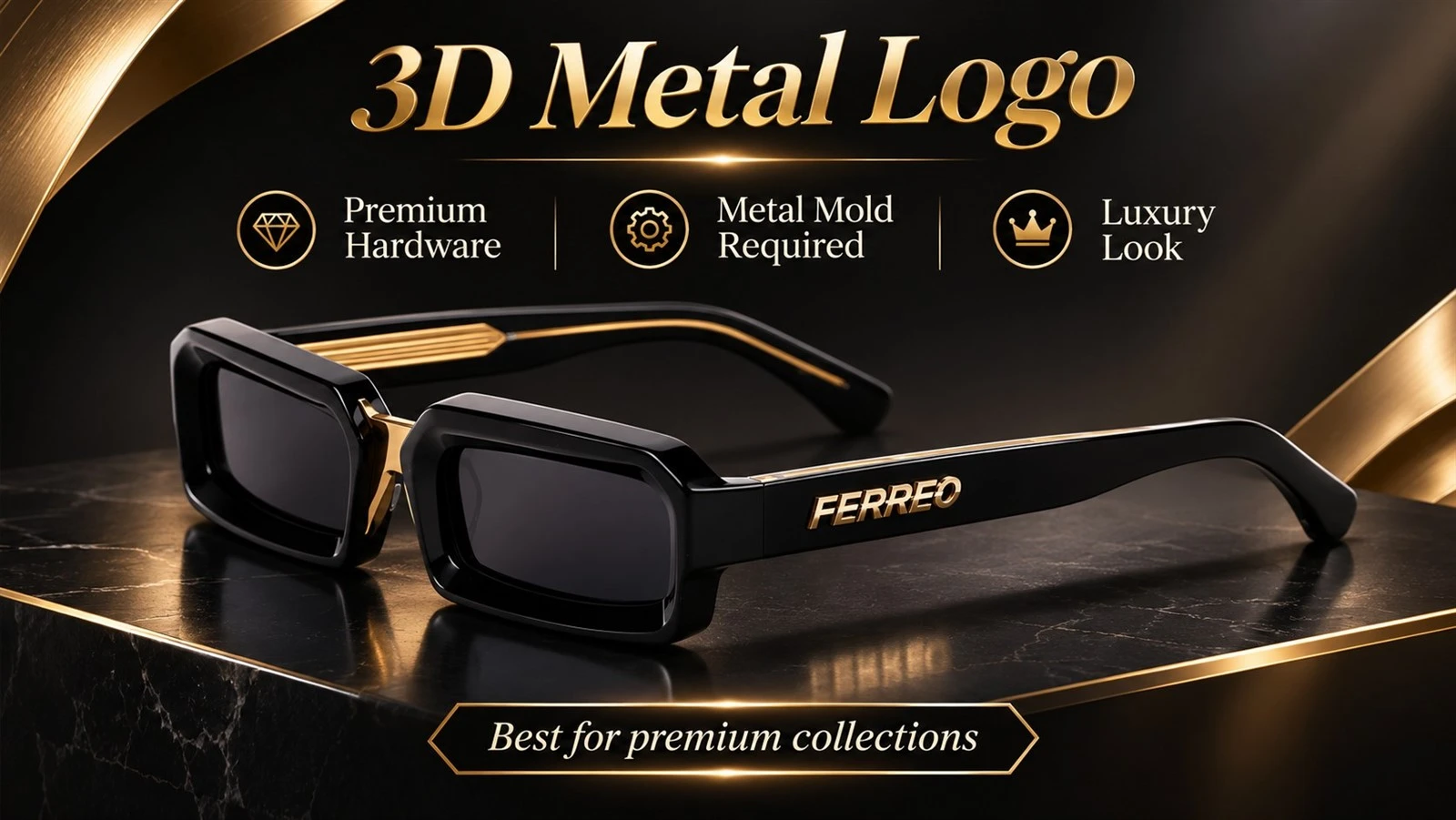
1.5 3D Metal Logo - Best for Premium Private Label Sunglasses
A 3D metal logo is a separately manufactured metal emblem attached or integrated into the eyewear frame.
Unlike a printed or engraved logo, it creates a physical brand detail with visible depth.
This method can be considered for acetate, plastic, and metal sunglasses, although the attachment structure must suit the frame.
For example, a premium acetate sunglasses collection may feature a small metal emblem near the hinge. The emblem becomes part of the product's visual identity.
Advantages: Distinctive three-dimensional branding, premium visual positioning, and consistency across a coordinated collection.
Limitations: A custom metal logo mold is required. The emblem's dimensions, attachment method, and frame structure must be evaluated before production.
The metal logo mold is separate from a complete eyewear frame mold. However, structural changes to accommodate the emblem may create additional tooling requirements.
For brands expecting repeat orders, the initial tooling investment can be spread across multiple production batches.
2. Five Sunglasses Logo Methods Compared: MOQ, Cost, Lead Time and Placement
The following table summarizes Finewell Eyewear's reference requirements for logo customization.
| Logo Method | Placement | MOQ | Main Cost Factors | Logo Lead Time |
|---|---|---|---|---|
| Laser Engraving | Frames, temples, selected lens areas | 20 pairs | Logo size, positions, complexity | 3–7 days |
| Laser + Paint Filling | Acetate frames only | 50 pairs | Engraving, paint filling, finishing | 7–10 days |
| Screen Printing | Suitable frame and lens areas | 50 pairs | Screen preparation, colors, quantity | 5–7 days |
| Hot Stamping | Frames only | 80 pairs | Stamping die, foil, quantity | 7–10 days |
| 3D Metal Logo | Frames only | 500 pairs | Metal mold, emblem, attachment | 15–25 days |
Important: These are reference MOQs and estimated logo-processing periods, not guaranteed completion dates for fully manufactured sunglasses. Actual requirements depend on frame availability, materials, logo design, sample approval, and production scheduling.
Developing a new frame, changing mold structures, or adding customized packaging may require a separate production timeline.
3. How Do Logo Methods Affect MOQ and Production Lead Time?
MOQ is influenced by the preparation required for each branding method.
Laser engraving generally has a lower entry requirement because it does not need a separate physical logo mold.
Screen printing and hot stamping require additional preparation. Paint-filled engraving adds finishing steps, while 3D metal logos require custom component manufacturing.
However, logo MOQ and sunglasses manufacturing MOQ are not the same thing.
Adding a logo to available stock frames can require fewer pairs than developing an entirely new frame shape.
A buyer requesting 50 existing sunglasses with a printed logo is therefore discussing a different manufacturing project from a brand requesting 500 pairs with a new frame structure and metal emblem.
Lead time also depends on when the logo operation begins.
If suitable frames are already available, branding can start after artwork and sample approval. For newly manufactured frames, logo processing must be coordinated with the production schedule.
Buyers should always ask whether the quoted timeline includes sampling, bulk manufacturing, quality inspection, packaging, and shipping.
4. Which Sunglasses Logo Method Should You Choose for Your Brand?
The most expensive method is not automatically the best choice.
The correct branding approach should match the product's retail positioning and anticipated sales volume.
| Buying Situation | Recommended Method | Reason |
|---|---|---|
| Small startup order | Laser engraving | Low MOQ and simple branding |
| Premium acetate collection | Paint-filled laser engraving | Color contrast without separate hardware |
| Promotional or corporate sunglasses | Screen printing | Colored branding |
| Fashion boutique collection | Hot stamping | Metallic visual effect |
| Established premium eyewear brand | 3D metal logo | Distinctive physical brand identity |
A new brand testing several frame shapes should generally avoid expensive custom tooling until it has identified commercially viable styles.
For an established brand with repeat orders, a distinctive metal emblem may justify the additional development expense.
A useful buying strategy is to separate the first market test from the final premium collection.
Start with existing frames and relatively simple branding. Once the best-selling shapes and colors are established, evaluate whether more expensive logo components will improve the product's positioning.
For additional development options, explore Finewell's OEM/ODM sunglasses manufacturing services.
5. What Should Buyers Check Before Approving a Sunglasses Logo Sample?
A logo may look correct in a digital mockup but behave differently on a real frame.
Before approving bulk manufacturing, buyers should examine the actual decorated sample.
Check the Logo Size and Position
Confirm the logo's width, height, distance from the hinge, and orientation.
For temple logos, inspect both sides of the sunglasses. A design that appears balanced on one side may look poorly positioned on the opposite temple.
Check Color and Surface Finish
For screen printing and paint-filled engraving, compare the finished logo against the agreed color reference.
For hot stamping and metal emblems, inspect the metallic shade, edges, and overall consistency.
Check Adhesion and Durability
Printed and painted logos should withstand reasonable handling without obvious peeling or deterioration.
Agree on suitable adhesion, rubbing, or abrasion checks with the manufacturer before approving the sample.
For 3D metal logos, inspect attachment security and any protruding edges.
Check Comfort and Functional Areas
Logos must not interfere with hinges, temple movement, skin-contact areas, or lens performance.
Lens branding requires additional attention. A logo near the lens edge should not obstruct normal vision or compromise applicable optical requirements.
Approve a Physical Reference Sample
The final approved sample should establish the logo position, dimensions, color, finish, and acceptable workmanship.
Photographs are helpful, but a physical reference is particularly valuable for metallic effects, paint-filled engraving, and attached metal emblems.
6. How to Order Custom Sunglasses With Your Logo From Finewell Eyewear
Finewell Eyewear provides logo customization, frame selection, OEM/ODM development, packaging, and international shipping support.
You do not need to develop a new frame to begin building a private label sunglasses collection.
Step 1: Choose Your Sunglasses
Browse our wholesale sunglasses collection or provide a reference image.
Specify the required frame material, colors, lens type, and approximate quantity.
Step 2: Send Your Logo Artwork
Provide your logo in an editable vector format, preferably AI, EPS, or another compatible vector file.
Also indicate your preferred logo color, size, and placement.
Step 3: Compare Branding Options
Our team can evaluate suitable logo methods based on your frame material, design requirements, and order volume.
Request different quotation quantities to understand how tooling and setup fees affect unit costs.
Step 4: Approve the Logo Sample
Review the actual logo appearance, position, finish, and attachment quality before authorizing bulk processing.
Step 5: Confirm Production and Shipping
After sample approval, confirm the purchase specifications, packaging requirements, production schedule, and shipping arrangement.
Finewell can coordinate these stages as part of its one-stop eyewear manufacturing service.
Ready to compare your options? Contact Finewell Eyewear with your logo and desired quantity. Ask for a quotation comparing the most suitable branding methods.
7. Frequently Asked Questions About Custom Sunglasses With Logo
7.1 What is the minimum order quantity for custom sunglasses with logo?
At Finewell, laser engraving starts from 20 pairs. Paint-filled engraving and screen printing start from 50 pairs, hot stamping from 80 pairs, and custom 3D metal logos from 500 pairs.
These figures apply to logo customization under suitable production conditions. Full OEM frame development may have different MOQs.
7.2 Can I add my logo to existing sunglasses without designing new frames?
Yes. Existing sunglasses are often the simplest starting point for private label branding.
Select a suitable stock model, confirm the logo method and position, and approve a branded sample. New frame molds are generally unnecessary when the original frame structure remains unchanged.
7.3 Which logo method is best for acetate sunglasses?
Laser engraving with paint filling is a strong option for acetate frames when a colored, recessed logo is desired.
Hot stamping works well for metallic finishes, while 3D metal emblems suit brands looking for a more prominent hardware detail.
7.4 Can I print a custom logo on sunglass lenses?
Yes, selected lens areas can accommodate suitable printing methods, depending on the lens material and coating.
Lens-edge branding is generally preferable to placing a logo in the main viewing area. The method must be approved for the particular lens construction.
Not every laser or ink process is suitable for every lens.
7.5 Do 3D metal sunglasses logos require a custom mold?
Yes. A newly designed 3D metal emblem normally requires dedicated logo tooling.
This does not necessarily mean the sunglasses frame needs an entirely new mold. Additional frame modifications depend on how the emblem is attached.
7.6 What logo file format should I send to the manufacturer?
Editable AI or EPS files are preferred. Compatible vector PDF or SVG artwork may also be accepted.
Vector files preserve the accuracy of small letters and fine lines when resized. Adobe's vector file guidance explains why these formats are useful for scalable graphics.
If you only have a PNG or JPG, send the highest-quality version available and ask whether the artwork needs to be redrawn.
Conclusion: Choose the Right Logo Method Before Bulk Production
Custom sunglasses with logo offer a practical way to introduce your brand without necessarily investing in an entirely new eyewear design.
Laser engraving is suitable for smaller orders. Paint-filled engraving adds color to acetate frames. Screen printing supports colored branding, hot stamping creates metallic finishes, and 3D metal logos offer a more distinctive physical detail.
The smartest purchasing decision balances visual appearance, MOQ, tooling costs, and production timing.
Before placing a bulk order, confirm the branding method on a real sample and compare the complete landed cost rather than the logo price alone.
Build your next private label sunglasses collection with Finewell Eyewear.
Contact Us for Logo Samples and 3 Pricing Options
Send us your sunglasses design, logo artwork, target quantity, and destination country. We can help you compare suitable logo methods and plan your next production order.
No Information


