

How Retailers Can Build A Product Assortment Of Wholesale Eyeglass Frames

A balanced assortment of wholesale eyeglass frames starts with a small set of commercially useful shapes, enough fitting sizes, several material choices, and clear retail price tiers. For a new optical store, 15–25 well-chosen styles can be a sensible planning range-not a rule.
The usual first-order mistake isn't ordering too few fashionable frames. It's buying six nearly identical rectangles, overlooking narrow or wide fittings, and filling the display with colors that look attractive in a catalog but barely move in-store. Cash gets tied up while customers still say, "Do you have anything that fits me better?"
This guide shows how to divide an opening range by shape, fit, material, color, and price. There's also a worked 20-style buying plan, an illustrative budget, and straightforward rules for deciding what to reorder-or stop carrying.
Which Eyeglass Frame Shapes Should a New Retailer Stock First?
Start with familiar silhouettes rather than chasing every new design. Your first selection should serve different preferences, not simply show how many designs your supplier has.
| Frame shape | Role in the assortment | What to look for |
|---|---|---|
| Rectangular | Conservative, work-friendly option | More than one width; avoid overly shallow lenses |
| Soft square | Versatile everyday choice | Rounded edges and comfortable bridge geometry |
| Round | Alternative to angular designs | Appropriate lens diameter and stable nose fit |
| Oval | Understated, often compact | Balanced proportions and useful narrow sizes |
| Cat-eye | Defined fashion option | Wearable lift rather than an extreme silhouette |
| Browline | Recognizable classic | Secure construction at the upper rim |
| Geometric or slim rectangle | Small trend experiment | One distinctive piece, not a whole wall |
Rectangles and soft squares make useful anchors, but a store selling mainly to students may need a different emphasis from one serving office workers or older prescription customers. Watch what visitors actually try on.

How Many Frame Styles Are Enough for a First Wholesale Order?
There is no universal number. Work backward from four limits: display capacity, local customer profile, purchasing budget, and supplier replenishment speed.
A 20-style assortment is a practical exercise for a small store because it gives shoppers visible choice without forcing the buyer to manage hundreds of designs. Yet 20 styles are not the same as 20 SKUs. One model offered in black and tortoiseshell, each in two sizes, becomes four stock-keeping units.
Keep the opening display focused. If your supplier requires 50 pieces per model, ordering 20 models would mean at least 1,000 frames-potentially excessive for one new shop. Ask whether mixed-model opening orders, ready-stock quantities, samples, or staggered deliveries are available. If not, test 20 designs as display samples and place the initial commercial order on fewer proven models.
How Should Retailers Divide Men's, Women's, and Unisex Frames?
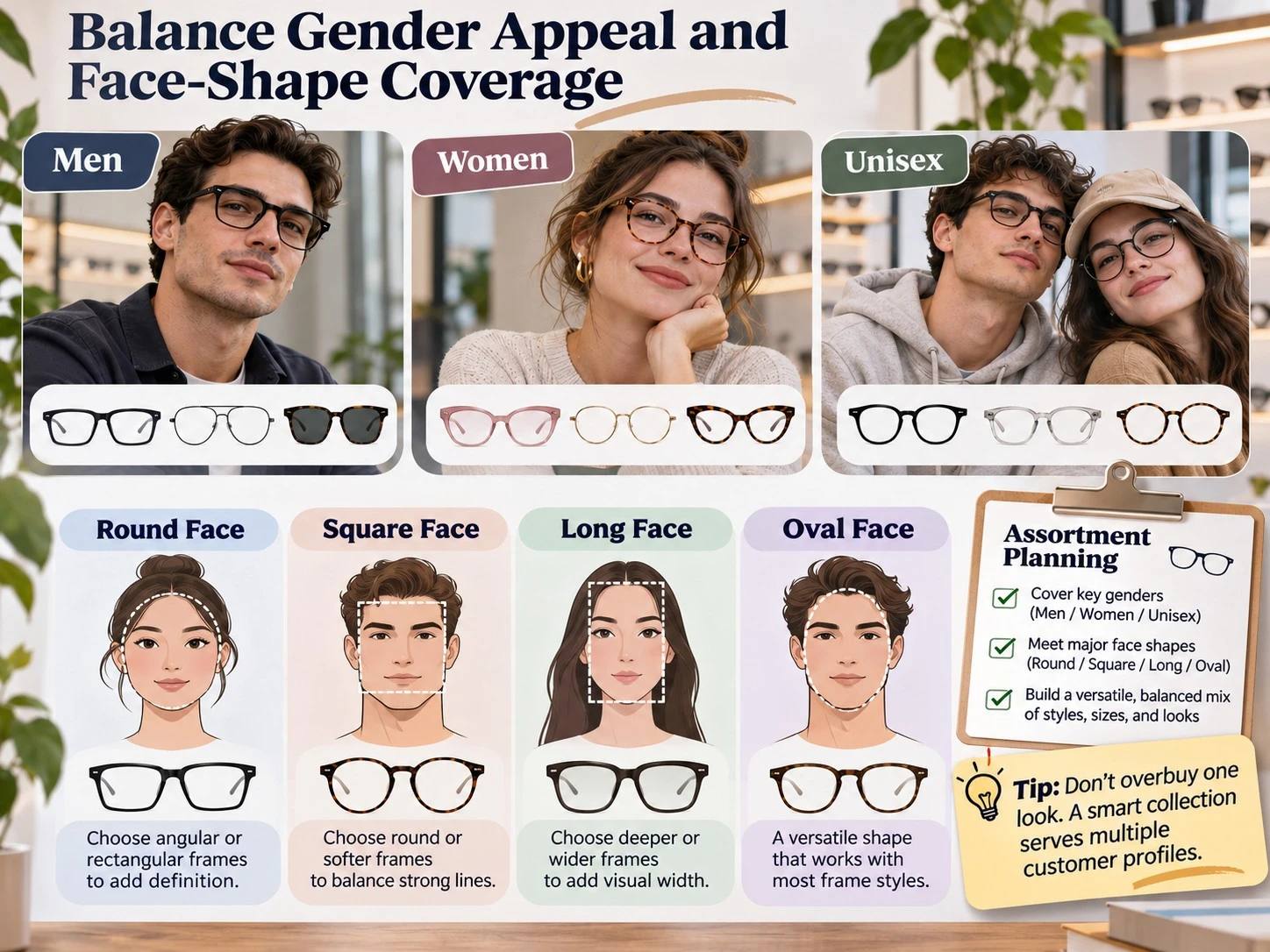
For a store without sales history, a working starting point is 25% traditionally men's designs, 25% traditionally women's designs, and 50% unisex. In a 20-style plan, that's five, five, and ten styles. This is a merchandising hypothesis, not an industry-wide demand statistic.
Style labels should not dictate fitting. A customer shopping from the "unisex" section may need a narrow bridge or wider temples; gender doesn't establish size. Prioritize actual shoppers and local demographics. If most visits come from women looking for bold acetate, adjust that mix.
How Do Face Shape and Frame Measurements Affect Selection?
Face-shape advice helps customers begin browsing, but fit decides whether they keep the frame on. Angular frames can contrast with round faces; softer shapes may appeal to people with square features. Neither is a rigid rule.
Buy across narrow, regular, and wide fittings. Reserve four designs for narrow fittings, twelve for regular, and four for wide; confirm actual measurements.
Check lens width, bridge width, temple length, overall front width, and lens height. The familiar marking 52□18–145 indicates nominal lens width, bridge size, and temple length in millimeters; it does not tell you the complete front width or guarantee bridge comfort.
Ask your dispensing optician or lens laboratory to review any unusually deep, curved, rimless, or slender frame before purchasing it for prescription use. Lens suitability depends on the prescription, glazing method, and frame construction-not appearance alone.
How Should Acetate, TR90, and Metal Fit Into the Range?
These materials do different jobs on the shelf.
| Frame material | Best assortment role | Points to inspect before ordering |
|---|---|---|
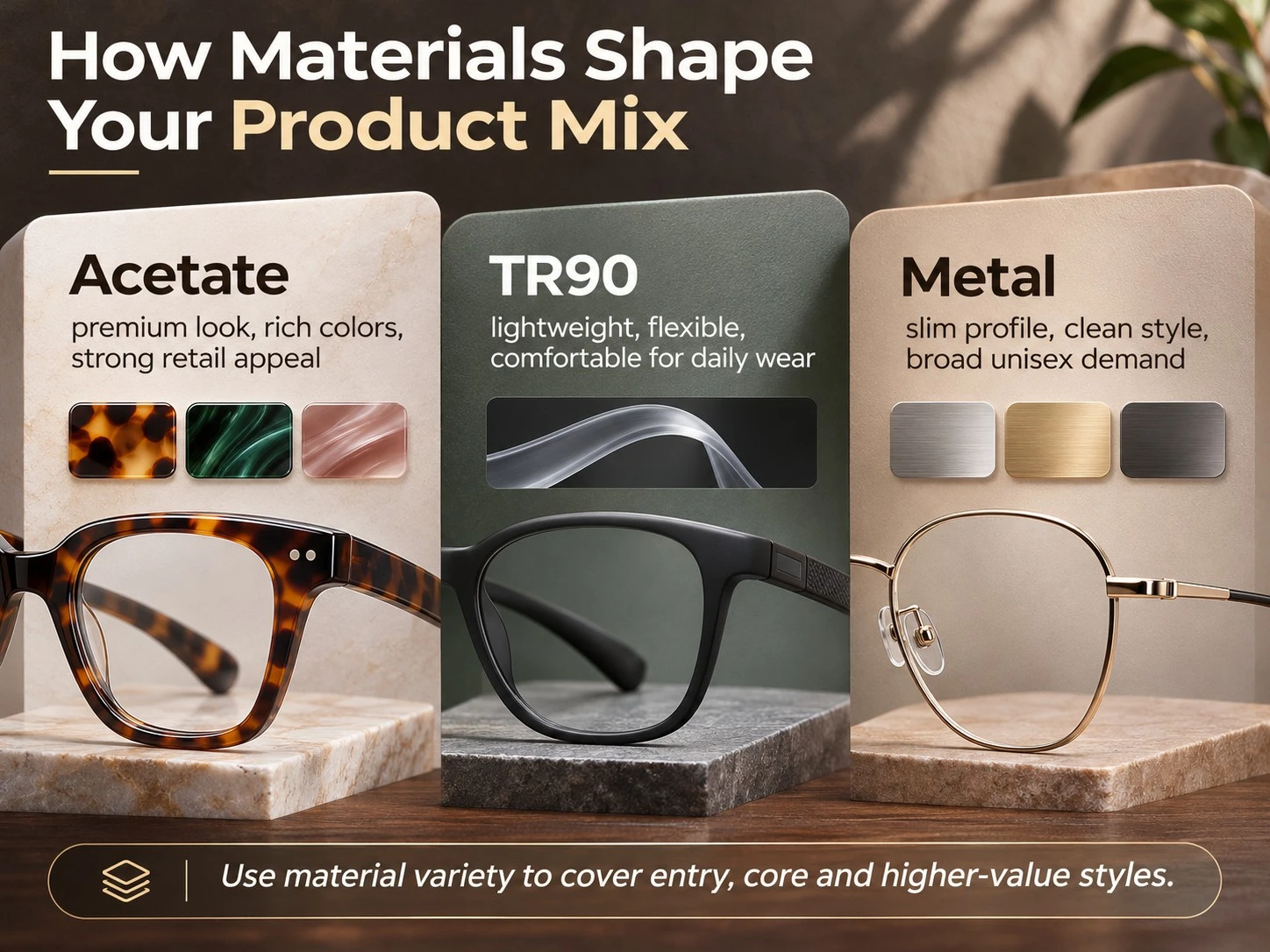
| Acetate | Visual character and mid-to-premium designs | Polish, edge finishing, hinge alignment, color consistency |
| TR90 | Lightweight, flexible everyday options | Fit retention, temple construction, actual material specification |
| Metal | Slim, understated or premium-looking frames | Plating finish, adjustable pads, joints, skin-contact materials |
Acetate is useful when the customer wants visible thickness, layered colors, or a more distinctive design. TR90 can earn its place with comfortable, lightweight everyday styles. Metal adds slimmer profiles and adjustable nose-pad options that may solve a fit problem plastic bridges cannot.
For an opening range, eight acetate, seven TR90, and five metal designs is one reasonable trial allocation. Allocate by each model's purpose and replenishment speed, not symmetry.
Should Different Materials Receive Equal Inventory?
No. Give more units to models with broader customer appeal and reliable replenishment, not automatically to the material category with the most styles. Two acetate rectangles in different colors may compete for exactly the same sale. A metal frame with an adjustable bridge could meet demand neither rectangle can satisfy.
Separate assortment breadth (how many designs you show) from inventory depth (how many pieces you keep). A trend-led design may deserve fewer units than a proven daily-wear frame.
How Should Retailers Balance Basic Colors, Patterns, and Seasonal Shades?
For a 20-style opening display, try 12 neutral primary colorways, five patterned or translucent colorways, and three seasonal colors. Think black, brown, gray, and clear for the core; tortoiseshell, layered acetate, and subtle transparent finishes for character; then a few current accents.
These 60/25/15 proportions are a test plan, not published sales averages. Count colorways separately from designs: a black square and the identical square in amber are one design but two sellable variants.
Ask whether the second color genuinely offers another choice or just duplicates inventory.
How Can Retailers Build Entry, Core, and Premium Price Tiers?
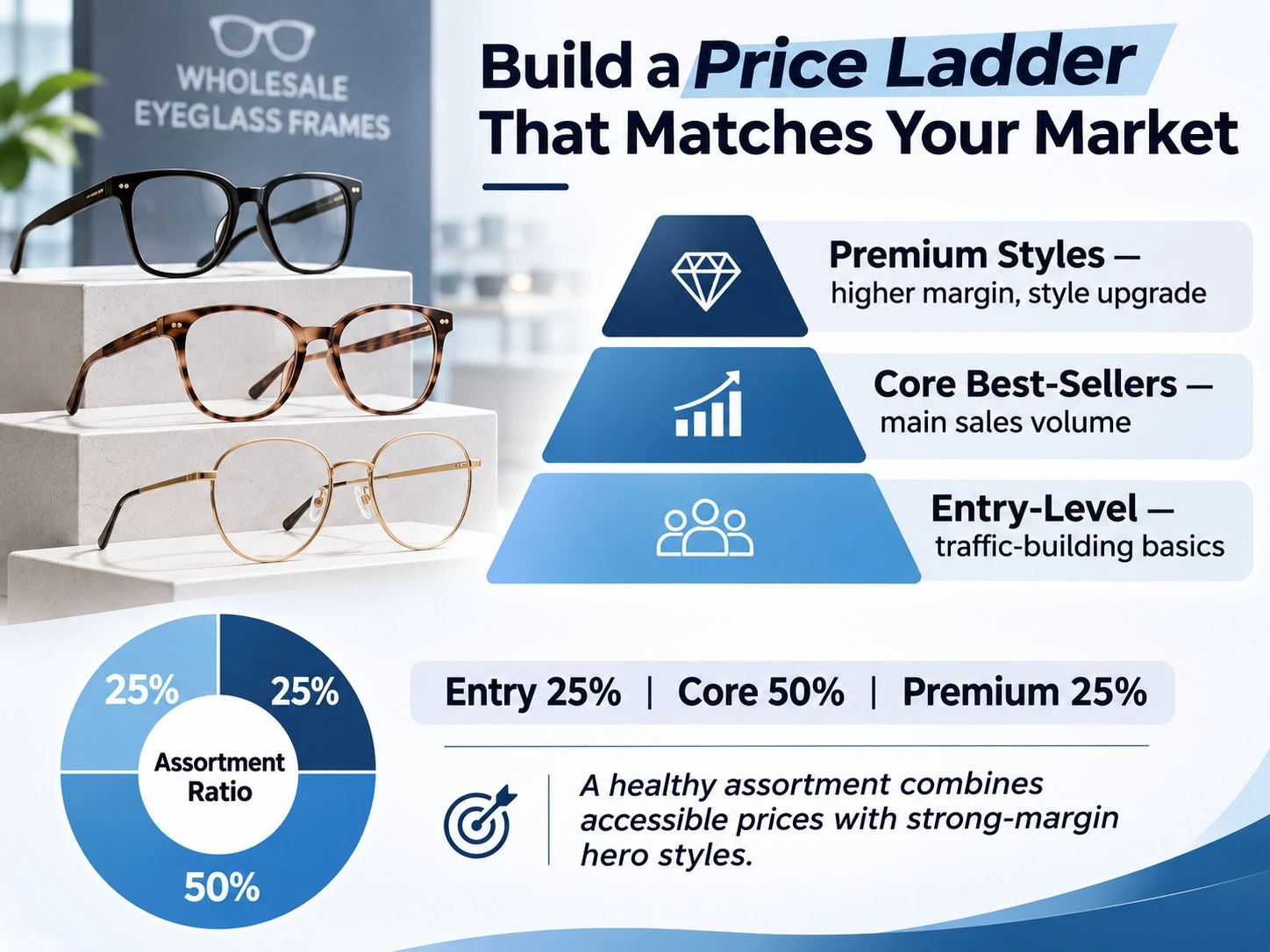
Let price tiers reflect your target customer rather than buying everything at one wholesale cost. An opening mix of four entry-level, twelve core, and four premium styles gives the largest share of display space to the products you expect most customers to consider.
| Tier | Styles in a 20-style plan | Purpose | Buying priority |
|---|---|---|---|
| Entry | 4 | Accessible first choice or second-pair option | Consistency, comfort, sensible landed cost |
| Core | 12 | Main everyday selling range | Fit coverage, repeatability, strong perceived value |
| Premium | 4 | Design, finish, or material upgrade | Noticeable difference customers can assess in person |
Lens work, adjustments, staffing, returns, rent, taxes, and local market expectations all influence the business model.
How Should a Retailer Calculate Its Frame Purchasing Budget?
Budget on landed cost, not the number printed in a supplier catalog. Include frame purchases, shipping, import duties where applicable, sample or inspection expense, and a reserve for replacements or restocking.
Here's an illustrative opening budget assuming a supplier can sell four pieces per design across 20 designs. These are planning figures, not Finewell quotations or market averages.
| Budget item | Calculation | Amount (USD) |
|---|---|---|
| Entry frames | 4 styles × 4 units × $10 | $160 |
| Core frames | 12 styles × 4 units × $17 | $816 |
| Premium frames | 4 styles × 4 units × $29 | $464 |
| Shipping and import charges | Placeholder estimate | $260 |
| Samples and quality checks | Placeholder estimate | $100 |
| Contingency and reorder reserve | Cash held back | $300 |
| Total planned cash | 80 frames plus allowances | $2,100 |
The opening inventory purchase itself is $1,440. The remaining $660 is not additional frame inventory. Replace every placeholder with a quote based on your destination and delivery terms. If minimum order quantities make an 80-piece mixed assortment impossible, change the buying method or scale the plan; don't quietly turn a test order into 1,000 pieces.
Example: A 20-Style Wholesale Eyeglass Frames Assortment
This sample range is for a general optical retailer serving mixed adult customers. Each row represents distinct designs, not color or size variants. The material counts total exactly 20.
| Shape group | Acetate | TR90 | Metal | Total styles | Commercial reason |
|---|---|---|---|---|---|
| Rectangular | 1 | 2 | 1 | 4 | Everyday and office appeal |
| Soft square | 3 | 1 | 0 | 4 | Flexible styling across ages |
| Round | 1 | 1 | 1 | 3 | Softer alternative |
| Oval | 1 | 0 | 1 | 2 | Compact or understated choice |
| Cat-eye | 2 | 1 | 0 | 3 | Distinctive fashion offer |
| Browline | 0 | 1 | 1 | 2 | Classic, structured option |
| Geometric | 0 | 0 | 1 | 1 | Controlled trend test |
| Slim rectangle | 0 | 1 | 0 | 1 | Contemporary small experiment |
| Total | 8 | 7 | 5 | 20 |
Now apply the other allocations across those 20 designs: five men's, five women's, ten unisex; four narrow, twelve regular, four wide; twelve neutral, five patterned, three seasonal; four entry, twelve core, four premium. These are overlapping attributes, not additional styles.
Arrange samples by silhouette and front width; remove near-duplicates.
Browse Finewell's wholesale optical eyewear collection to compare real product categories against this buying plan.
How Can Sales Data Tell Retailers What to Reorder or Discontinue?
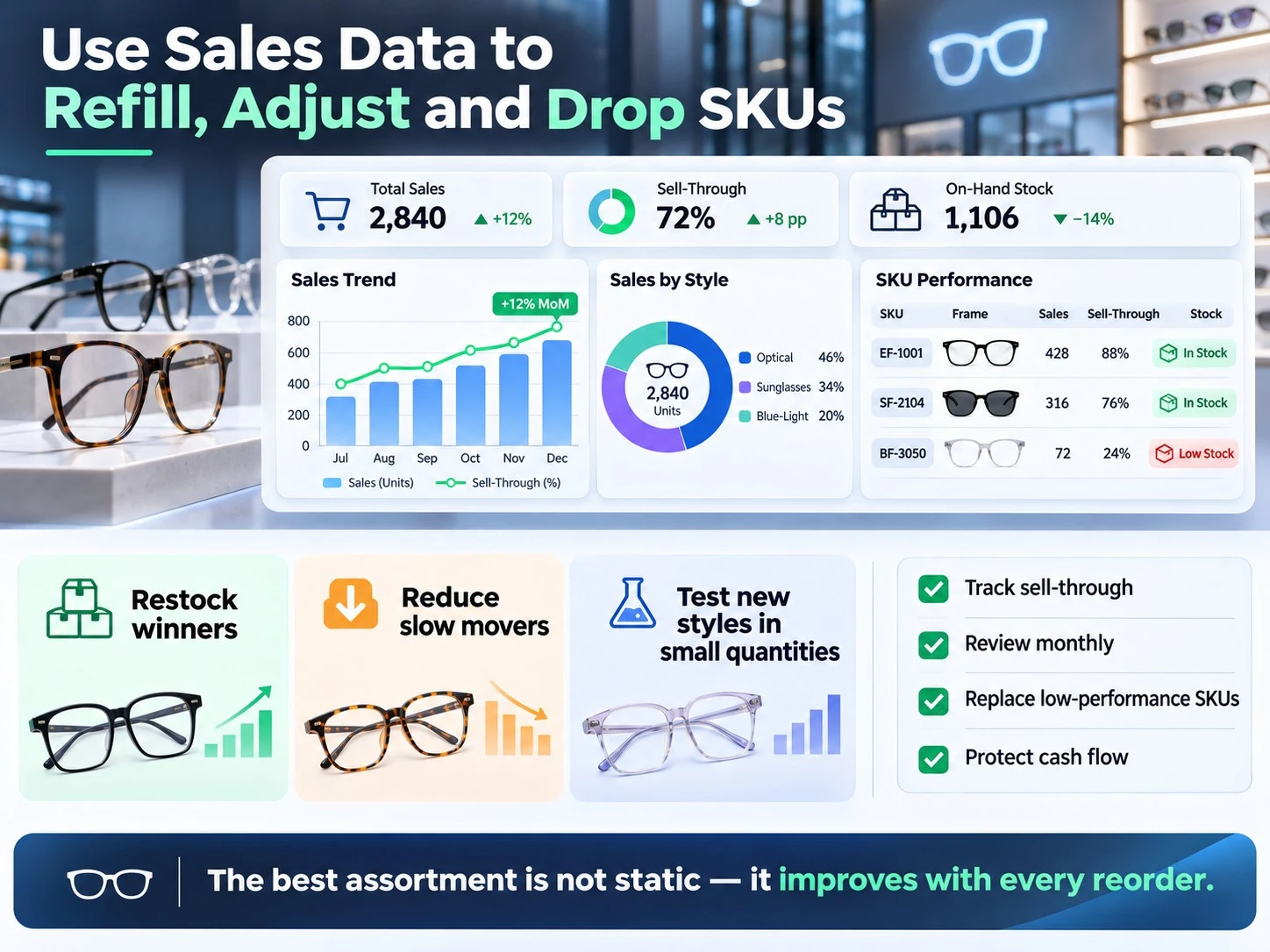
The best assortment is the one you revise. Review individual model-color-size SKUs after roughly 30, 60, and 90 days, while noting that low-volume stores may need longer to see a meaningful pattern.
| Signal | What it suggests | Practical response |
|---|---|---|
| High sell-through and repeated requests | Demand may exceed initial depth | Check availability and plan a reorder |
| Frequent try-ons, few sales | Style attracts interest but something blocks purchase | Check fit, price, comfort, and lens compatibility |
| Slow sales but unique fit role | Niche product may still be necessary | Retain one display option; reduce backup units |
| Slow sales and overlapping alternatives | Inventory duplication | Stop replenishing; test another silhouette |
| Returns or adjustment complaints | Potential quality or fit issue | Inspect samples and talk to the supplier before reordering |
For an opening batch with no replenishment yet, sell-through = units sold ÷ units received. Selling three of four pieces gives 75% sell-through; that's promising, but four pieces is a tiny sample. Don't treat it as a forecast by itself.
Record lost sales too: "Need narrower bridge," "Wanted silver," or "Too expensive with lenses." A missing size or wrong price tier can explain slow sales.
When Should Retailers Reorder Bestselling Frames?
Reorder before the shelf is empty. A simple rule is:
Reorder point = average daily unit sales × total replenishment lead time in days + safety stock.
Suppose one frame sells six units a month, or about 0.2 a day. Production plus delivery takes 30 days, and you want a two-unit buffer. The reorder point is 0.2 × 30 + 2 = 8 units. When available inventory approaches eight, it's time to place the next order.
Notice the problem for a small shop holding only four pieces: under these assumptions, it is already below the reorder point. It needs faster ready-stock replenishment, pooled stock across branches, or a different opening quantity. Don't pretend that a spreadsheet formula makes a long lead time disappear.
The Australian Government's inventory-management guidance also recommends using sales rates, delivery times, seasonal peaks, and supplier reliability when setting reorder points, with regular physical stocktakes.
What Should Retailers Confirm With a Wholesale Frame Supplier?
A beautiful catalog is not enough. Before paying a deposit, request model-level details and check the actual sample:
Fit and specification: lens width, bridge, temple length, overall width, available colors and sizes, frame and hinge materials.
Quality and documentation: inspection approach, test evidence where relevant, spare parts, and handling of defects. ISO 12870:2024 sets requirements and test methods for unglazed spectacle frames intended for prescription lenses; ask which tests apply to your products.
Market requirements: documentation appropriate to your destination. For EU sales, ask about applicable REACH restrictions, including nickel release from relevant metal components; the European Commission explains the nickel restriction.
Commercial terms: MOQ per design, color and size; mixed-model ordering; unit-price tiers; samples; production and shipping timelines; Incoterms and payment terms.
Repeatability: whether the same design can be reordered later, how color batches are controlled, and what happens if a model is discontinued.
Ask for both an opening-order quote and a repeat-order plan.
Frequently Asked Questions About Wholesale Eyeglass Frame Assortments
1. Should I buy more frame styles or more units of fewer styles?
For a new shop, build enough style and fit variety to learn what customers want, but keep quantities shallow where your supplier allows it. After the first sales cycle, deepen stock in proven winners. A large MOQ may mean testing fewer designs initially.
2. Is a 20-style display enough for a small optical store?
It can be a starting point for a focused boutique. A store serving children, specialist prescriptions, or several distinct customer groups may need additional categories.
3. Are acetate frames always more premium than TR90 frames?
No. Construction, finishing, component quality, fit, and brand positioning matter. Acetate can support richer visual effects; TR90 can deliver practical lightweight comfort. Evaluate the actual model rather than assuming a material alone determines quality.
4. Can I launch with only black and tortoiseshell frames?
You can, but you may miss customers who want lighter finishes or a distinct look. Start with dependable neutrals, then test a few patterned and seasonal colors. Track sell-through by color, not only by model name.
5. Should I customize frames before my store has sales data?
Usually, start with existing models unless you already know your audience and have a clear brand position. Once a shape, fit, and price tier works, customization becomes a more informed decision. Finewell's OEM/ODM eyewear services can be considered when you are ready to discuss logos, colors, packaging, or design changes.
Conclusion: Build a Balanced Frame Range, Then Improve It With Sales Data
A strong opening range covers shapes, fits, materials, colors, and prices without duplicating the same choice twenty times. Begin with a manageable trial, keep a record of what customers reject as well as what they buy, and use real replenishment lead times to guide repeat orders.
Planning your first retail frame order? Send Finewell your target market, retail price bands, preferred materials, and approximate style count through our contact page. Ask for a model shortlist, available size and color options, and three purchasing scenarios: ready-stock trial, mixed-model wholesale order, and OEM/ODM customization. Compare the MOQ and landed cost of each before committing.


