

B2B Eyewear Wholesale: A Buying Guide For Retailers, Distributors And Private Label Brands

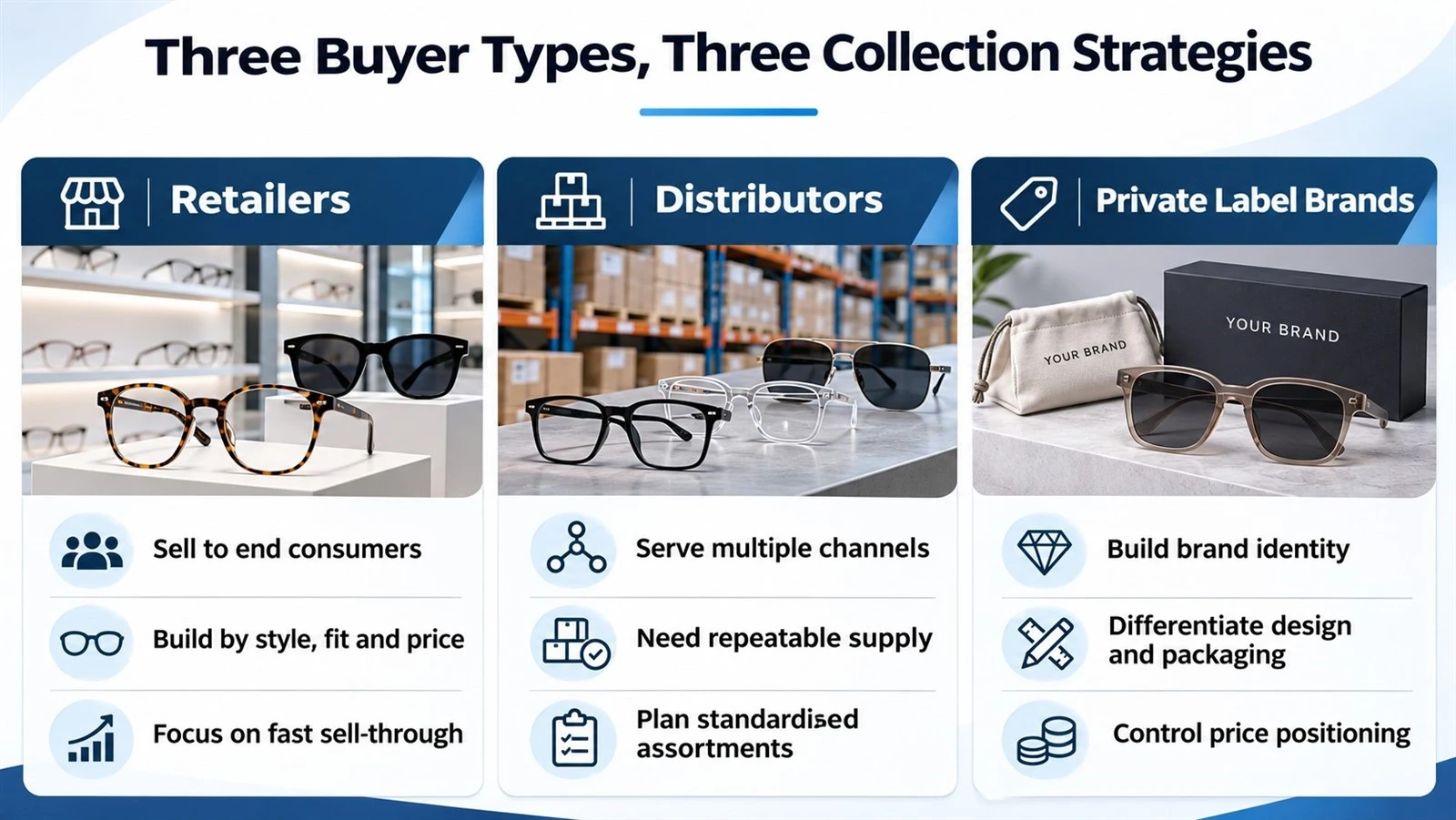
B2B eyewear wholesale collections should be built around your business model, not simply a supplier's bestselling catalog. Retailers need products that match their customers and sell consistently. Distributors need versatile collections that different retail channels can reorder. Private label brands need recognizable designs that support their positioning without creating unnecessary development costs.
The same eyewear supplier can serve all three buyers, but the buying strategies should be different.
| Buyer Type | Main Priority | Recommended Starting Point |
|---|---|---|
| Retailer | Customer fit, sell-through and retail margins | A balanced assortment based on existing customer demand |
| Distributor | Channel coverage, reliable supply and inventory turnover | Standardized styles with repeat-order potential |
| Private Label Brand | Brand identity, product differentiation and profitability | A focused collection combining proven frames and custom details |
Before requesting a wholesale quotation, identify which business model best describes your company. That decision determines how many styles you need, how much customization makes sense and how you should manage future orders.
How Should Retailers Build a Wholesale Eyewear Collection?
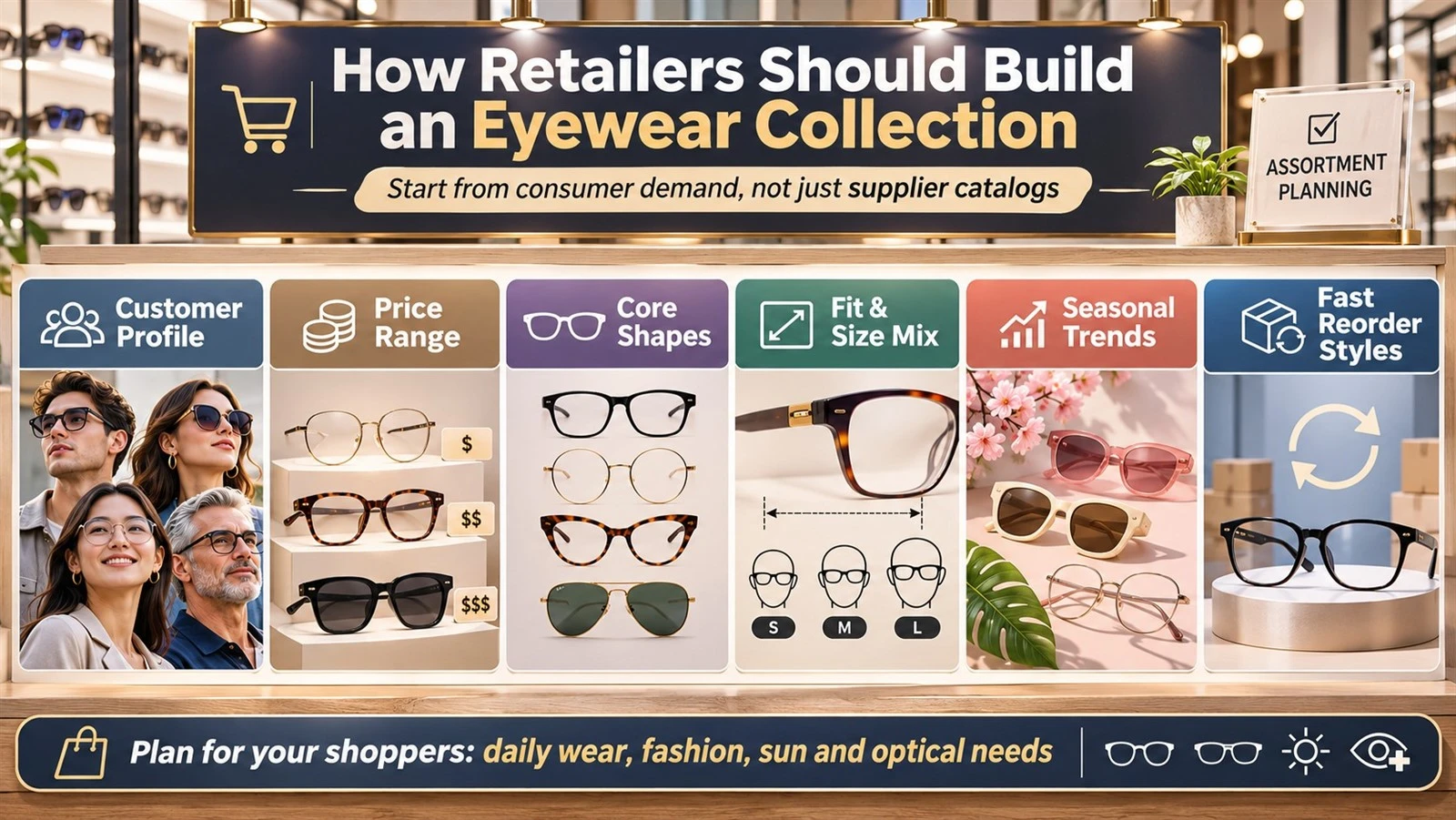
Retailers should select eyewear based on the people who actually visit their stores, their purchasing budgets and their reasons for buying glasses.
A frame that sells well in a fashion boutique may perform poorly in an optical store. Likewise, a popular seasonal sunglass may not be the right product for a retailer whose customers primarily need prescription-ready frames.
The supplier's catalog should provide options. Your customers should determine the final selection.
Start With Customer Demand, Not Frame Trends
Before choosing products, review three aspects of your retail business:
1. Who are your main customers?
Consider their age groups, typical spending levels, style preferences and fitting requirements.
A boutique serving younger fashion-conscious customers may benefit from small cat-eye frames, narrow rectangles and seasonal colors.
An optical store serving working professionals may need more classic rectangular frames, lightweight metal styles and comfortable acetate designs.
2. Why are customers purchasing eyewear?
Different purchasing motivations require different products.
| Customer Need | Recommended Eyewear Direction |
|---|---|
| Everyday prescription wear | Comfortable acetate, TR90 and metal optical frames |
| Fashion accessories | Cat-eye, oversized and contemporary geometric frames |
| Driving and outdoor activities | Suitable sunglasses with verified UV protection and optional polarized lenses |
| Premium eyewear | Acetate frames, refined hardware and distinctive finishing |
| Lightweight daily wear | TR90 and slim metal frame designs |
3. Which price points are missing from your collection?
A retailer should not fill the entire display with products at the same price.
Entry-level frames attract price-sensitive customers. Mid-range styles provide broader commercial choices. Premium frames create opportunities for higher-value purchases.
The right balance depends on your store's actual sales history.
Balance Commercial Styles With Fashion Products
For a retailer planning an initial ten-SKU collection, a practical starting point is:
- 60% core products: Classic rectangles, squares and versatile optical frames.
- 30% differentiated products: Premium acetate, polarized sunglasses or distinctive frame materials.
- 10% experimental products: Seasonal colors or fashion-driven silhouettes.
These are suggested planning allocations, not industry averages.
The purpose is to avoid investing too heavily in products that may look attractive but have uncertain demand.
Frame fit is equally important. A retailer should consider lens width, bridge size, temple length and overall frame width alongside face shape and styling.
For prescription frames, ask suppliers about lens compatibility and relevant product testing.
Retail buying question: "Which products are customers asking for that we cannot currently offer?"
Answer that before adding another ten fashionable designs.
Explore Finewell's wholesale optical eyewear collection to compare frame materials and styles.
How Should Eyewear Distributors Build Collections for Different Sales Channels?
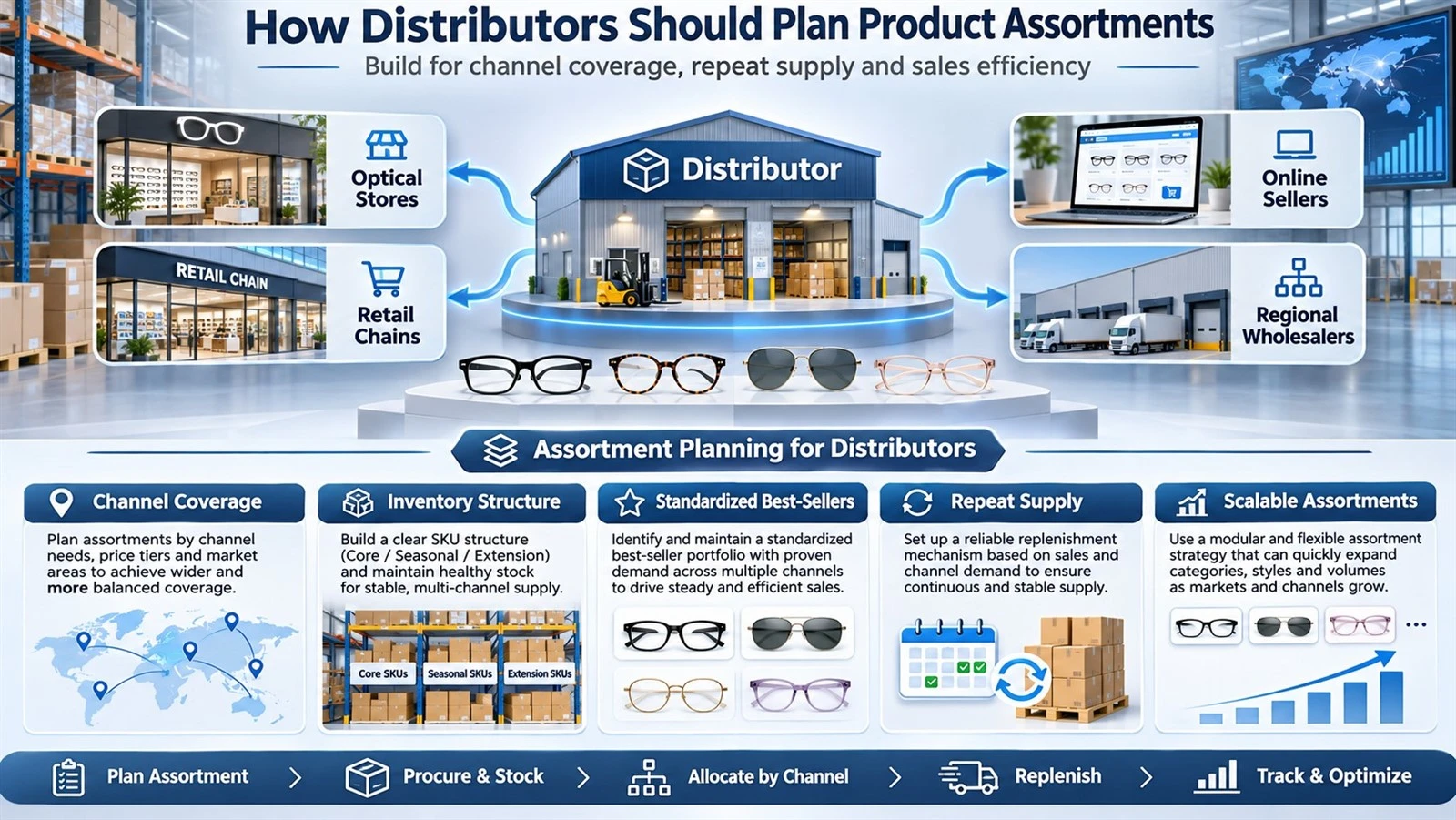
Unlike retailers, distributors typically supply multiple downstream customers rather than selling primarily to one consumer audience.
Their buying challenge is therefore more complex.
A distributor might serve optical stores, fashion boutiques, pharmacies, online sellers and regional wholesalers. Each channel has different price expectations, merchandising requirements and reorder patterns.
A successful distributor collection must provide enough variety to serve these customers without creating excessive inventory complexity.
Organize Products by Sales Channel
Instead of building a catalog entirely around frame shapes, organize your assortment according to the channels you serve.
| Distribution Channel | Core Product Requirements | Main Buying Consideration |
|---|---|---|
| Optical stores | Prescription-ready frames, reliable sizing, material variety | Consistent specifications and repeatability |
| Fashion boutiques | Trend-driven sunglasses and distinctive colors | Design appeal and seasonal updates |
| Pharmacies | Reading glasses and practical everyday styles | Clear specifications and easy replenishment |
| Online retailers | Commercial designs, consistent colors, detailed specifications | Reliable product information and photography |
| Outdoor retailers | Polarized sunglasses and activity-appropriate designs | Verified lens performance and product function |
For example, a distributor supplying optical stores may maintain a strong selection of black, tortoiseshell and neutral-colored frames.
The same distributor could offer a smaller seasonal selection of oversized sunglasses to fashion boutiques.
These collections can share suppliers and purchasing operations without requiring identical product assortments.
Standardize Products to Simplify Reorders
Distributors should evaluate more than the appearance of each product.
They need to know whether the manufacturer can supply the same style again with consistent materials, dimensions, color specifications and quality.
Imagine that five retailers reorder the same bestselling rectangular optical frame.
If each batch has noticeable differences in frame width, hinge construction or color, the distributor may face complaints, returns and additional inspection work.
A better sourcing process establishes:
- Unique model numbers and color codes.
- Approved samples and product specification sheets.
- Consistent material and component requirements.
- Defined packaging and barcode information.
- Repeat-order lead times and discontinuation notices.
The goal is to make successful products easy to replenish across multiple customers.
Separate Stock Into Three Commercial Groups
Distributors can divide their inventory into three practical groups.
Core inventory: Frequently reordered products with relatively predictable demand.
Channel-specific inventory: Products intended for particular retailers, regions or selling environments.
Trial inventory: New designs purchased in limited quantities to test demand before wider distribution.
For example, a distributor could allocate most purchasing capital to proven styles while maintaining a smaller testing budget for emerging designs.
The exact allocation should follow sales data rather than a fixed industry percentage.
Distributor buying question: "Can this product generate repeat orders from several of our retail customers?"
That question is often more valuable than asking whether a frame is currently fashionable.
How Should Private Label Brands Develop a Differentiated Eyewear Collection?
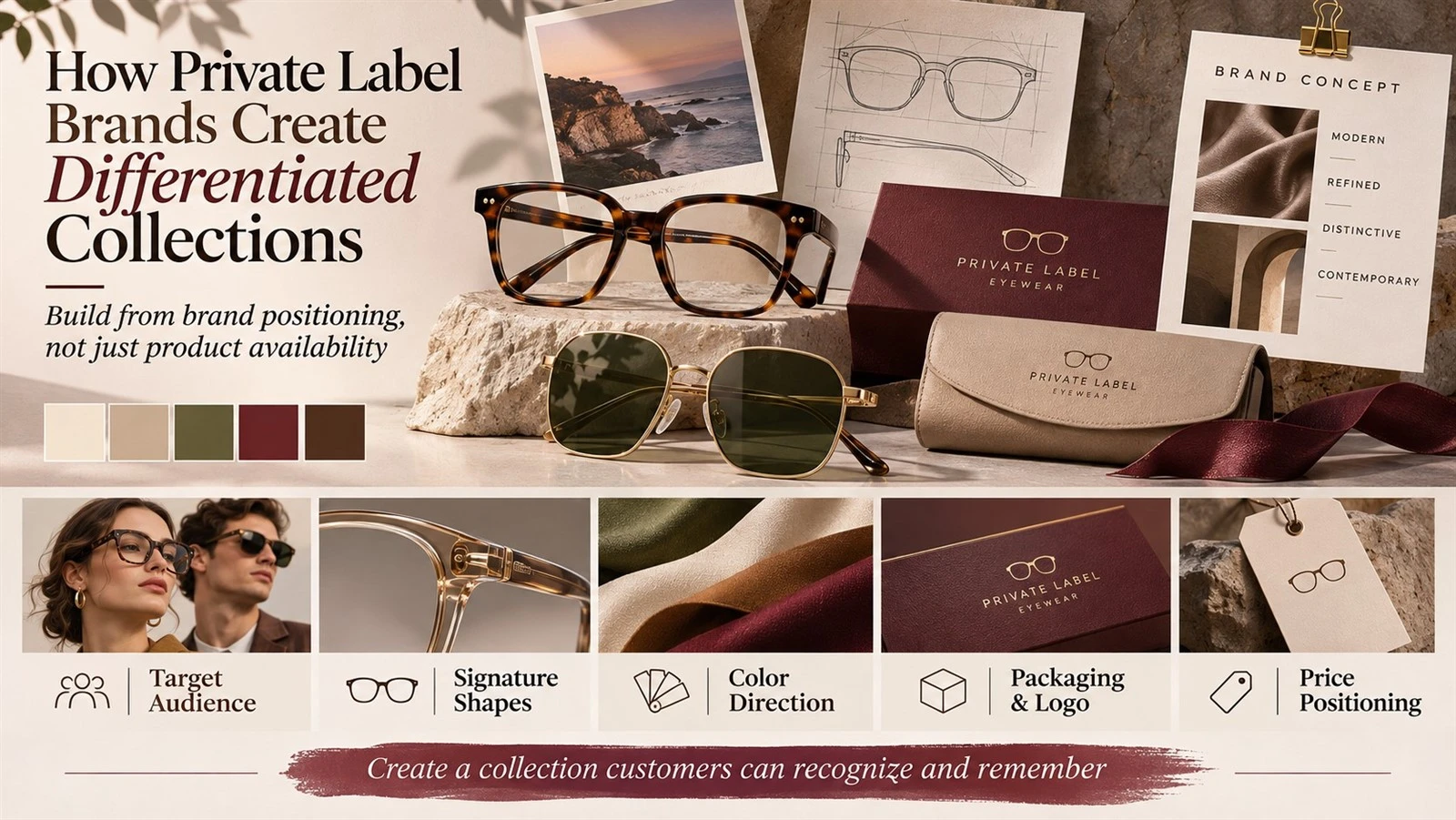
Private label eyewear buyers face a different challenge: their products must look and feel like they belong to one recognizable brand.
Purchasing ten unrelated bestselling frames and adding the same logo does not automatically create a coherent collection.
However, developing ten entirely new frame structures can also introduce unnecessary tooling expenses, sampling delays and inventory risks.
The better approach is to establish a consistent visual identity and apply customization selectively.
Define Your Brand Before Selecting Frames
Start with three questions:
1. Who is the brand designed for?
A minimalist professional eyewear brand will require a different collection from a colorful youth-oriented fashion label.
2. What makes the products recognizable?
Brand identity can come from consistent frame proportions, signature colors, material choices, distinctive temples or carefully designed logo placement.
3. What retail price should the collection support?
Your target selling price should guide material selection, lens specifications, packaging and manufacturing costs.
For example, premium acetate frames may be appropriate for a design-led brand seeking a more refined appearance.
TR90 or PC frames may suit collections prioritizing lightweight construction, commercial pricing or specific functional requirements.
Material choice should support the intended product positioning rather than serve as an isolated selling point.
Build a Collection Around Shared Design Elements
Consider a brand developing a contemporary acetate eyewear line.
Instead of designing ten unrelated frames, it could select four core silhouettes and develop coordinated color variations.
The collection might share:
A signature temple design.
Black, tortoiseshell and translucent neutral colors.
Consistent logo positioning.
Matching hinge finishes.
Unified packaging and product presentation.
This creates a more recognizable product family while potentially reducing the number of new molds and components.
The important distinction is that ten sellable SKUs do not necessarily require ten separate frame structures.
Choose Where Customization Creates Real Value
Not every private label project requires a completely new mold.
| Customization | Commercial Benefit | Development Consideration |
|---|---|---|
| Logo customization | Establishes brand recognition | Placement, durability and application method |
| Frame color customization | Creates visual consistency | Color approval and per-color MOQ |
| Lens customization | Supports product positioning | Lens material, performance and testing |
| Packaging customization | Improves retail presentation | Packaging MOQ and unit cost |
| Exclusive frame development | Creates stronger product differentiation | Tooling, prototypes and longer development cycles |
A new brand might begin with existing frame structures, customized colors and branded packaging.
Once demand is established, it can invest in exclusive shapes that justify additional development costs.
How Finewell Supports OEM/ODM Eyewear Development
Finewell Eyewear supports buyers through frame selection, material specification, logo application, lens customization, sample development, packaging and production coordination.
For brands starting with an existing design platform, ODM-based customization can reduce development complexity.
For businesses requiring a distinctive frame structure or buyer-owned design, OEM development provides greater control over dimensions, components and appearance.
The important work happens before mass production: confirming drawings, testing samples, approving colors and documenting specifications.
A reliable development process should turn a brand concept into a repeatable production specification.
Learn more about Finewell's OEM/ODM eyewear services.
Example: Three Different 10-SKU Wholesale Eyewear Collections
How would a retailer, distributor and private label brand each build a collection with just ten SKUs?
The following examples illustrate three different purchasing strategies.
For clarity, each SKU represents one specific sellable combination of frame design, frame color and lens configuration. Additional colorways, reading powers or lens options would create additional SKUs.
These are illustrative assortments, not guaranteed bestsellers.
10-SKU Collection Comparison
| SKU | Retailer Collection | Distributor Collection | Private Label Collection |
|---|---|---|---|
| 01 | Black rectangular optical frame | Entry-level black optical frame | Signature black acetate optical frame |
| 02 | Tortoiseshell rectangular optical frame | Tortoiseshell optical frame | Signature tortoiseshell acetate frame |
| 03 | Transparent grey round optical frame | Lightweight TR90 optical frame | Translucent champagne signature frame |
| 04 | Slim metal oval optical frame | Classic metal optical frame | Soft rectangular black acetate frame |
| 05 | Acetate cat-eye optical frame | Premium acetate optical frame | Soft rectangular burgundy acetate frame |
| 06 | Black square sunglasses | Classic black wholesale sunglasses | Brushed gunmetal optical frame |
| 07 | Tortoiseshell polarized sunglasses | Polarized rectangular sunglasses | Signature black square sunglasses |
| 08 | Metal aviator sunglasses | Classic aviator sunglasses | Honey-brown signature sunglasses |
| 09 | Small cat-eye sunglasses | Sport-style wraparound sunglasses | Cream acetate cat-eye sunglasses |
| 10 | Lightweight sport sunglasses | Cat-eye sunglasses for fashion channels | Modern metal pilot sunglasses |
Why These Collections Are Different
1. The retailer collection focuses on consumer variety.
It provides different shapes, materials, fitting choices and product functions. The objective is to satisfy multiple purchasing needs within a limited retail display.
2. The distributor collection focuses on channel coverage.
It includes commercially familiar styles that can be offered to different types of downstream retailers. Product standardization and repeat-order availability are essential.
3. The private label collection focuses on brand consistency.
Several SKUs share design structures or visual details. This makes the collection feel more unified and can reduce unnecessary structural development.
The key lesson is that SKU count alone says very little about the quality of an assortment.
Ten carefully selected products can be commercially more useful than fifty unrelated styles.
Which Wholesale Eyewear Sourcing Model Fits Your Business?
Eyewear buyers generally have three practical purchasing options: ready stock, light customization and more extensive OEM/ODM development.
Each option offers a different balance of speed, flexibility, investment and product differentiation.
| Sourcing Model | Best For | Advantages | Main Limitations |
|---|---|---|---|
| Ready-stock wholesale | Retailers and market testing | Faster dispatch, smaller trial purchases where available | Limited exclusivity and customization |
| Light customization | Growing brands and distributors | Logos, selected colors, lenses and packaging | Customization-dependent MOQs and lead times |
| Full OEM/ODM development | Established brands and exclusive collections | Greater control over product design | More sampling, tooling and approval work |
When Should You Choose Ready Stock?
Ready stock makes sense when your priority is testing customer demand or filling an immediate assortment gap.
A retailer opening a new store may prefer ten existing styles over investing in ten customized products before collecting sales data.
When Does Light Customization Make Sense?
Light customization is appropriate when you already know the type of eyewear you want but need branding or differentiated product details.
For example, an online retailer may use an existing frame design with a customized logo, selected lens color and branded packaging.
When Is Full OEM/ODM Worth the Investment?
Full development becomes more attractive when your brand needs a distinctive structure, exclusive fit or recognizable design features that existing frames cannot provide.
Before committing, ask whether the expected sales volume can support development and tooling costs.
The best purchasing model is not necessarily the most customized one. It is the one that fits your stage of business.
How Can B2B Eyewear Buyers Manage MOQ, Lead Times and Replenishment?
A low unit price does not guarantee a profitable eyewear order.
Buyers also need to manage purchase quantities, production schedules, inventory holding costs and the possibility of unsold products.
These factors become more important when a collection includes multiple frame colors, lens options and packaging variations.
Understand the Different Types of MOQ
One of the most common sourcing mistakes is assuming that the supplier's minimum order quantity applies equally to every product configuration.
In practice, several minimums may apply.
| MOQ Type | What Buyers Should Confirm |
|---|---|
| Ready-stock MOQ | Minimum quantity per available model or color |
| Custom color MOQ | Minimum production quantity for each color |
| Logo MOQ | Minimum quantity for a particular branding process |
| Packaging MOQ | Minimum packaging quantity or print run |
| New mold MOQ | Minimum order and tooling requirements for a new structure |
Suppose a buyer wants five frame styles in four colors.
That creates twenty possible SKUs before lens variations.
Even if the overall order quantity seems sufficient, some individual color combinations may not meet the manufacturer's production minimum.
Ask your supplier for an MOQ breakdown by model, color and customization method-not just one number.
Plan Lead Times Around Approval Stages
Production time should not be confused with the complete order timeline.
A customized eyewear order may involve design confirmation, sample preparation, revisions, final sample approval, production, quality inspection and international transportation.
Buyers should confirm separate timelines for:
- Stock samples and customized samples.
- Sample revisions and approval.
- Bulk manufacturing.
- Pre-shipment inspection.
- Shipping and customs clearance.
For private label projects, material or hardware changes after sample approval can affect the schedule.
A practical solution is to approve a reference sample and written specification before production begins.
Frequently Asked Questions About B2B Eyewear Wholesale
1. How many SKUs should a new eyewear retailer start with?
There is no universal number. A ten-SKU pilot collection can be useful for testing different shapes, materials and price positions. The ideal assortment depends on display capacity, available capital and expected customer demand. Start with products you can monitor individually and expand based on sales results.
2. Should distributors offer the same eyewear collection to every retailer?
Not necessarily. Different channels have different customers and price expectations. Distributors should maintain a standardized core assortment while offering selected products for optical shops, fashion retailers, pharmacies and outdoor stores.
3. Can I start a private label eyewear brand without developing new molds?
Yes. Many brands begin with existing frame structures and customize logos, colors, lenses or packaging. This approach can reduce initial development complexity. Exclusive molds become more valuable when a brand needs distinctive dimensions or frame structures.
4. Which frame material is best for wholesale eyewear?
The right material depends on the target market and price positioning. Acetate suits design-led collections, TR90 is useful for lightweight frames, and metal supports slim, classic designs. PC is common in certain affordable or functional products. Finished construction and quality control matter as much as the material name.
5. How can buyers avoid excessive inventory?
Start with fewer variants, prioritize proven product categories and track sales at SKU level. Avoid launching several colors of every design before knowing which combinations customers prefer. For distributors, consolidate demand across retail accounts where practical.
6. What information should I send an eyewear supplier for a quotation?
Provide your business type, destination market, required frame categories, estimated quantity, target purchasing price, material preferences and customization requirements.
For OEM/ODM projects, include reference images, dimensions, logo artwork and packaging requirements where available.
A complete request allows the supplier to compare practical sourcing options rather than quote unsuitable products.
Conclusion: Build Your Eyewear Wholesale Strategy Around Your Business Model
Successful B2B eyewear wholesale purchasing starts with understanding how your business makes money.
Retailers need assortments their customers will actually buy. Distributors need products that serve multiple channels and remain available for repeat orders. Private label brands need recognizable collections that balance design differentiation with production costs.
These differences should guide your product selection, customization strategy, inventory planning and supplier evaluation.
At Finewell Eyewear, we work with retailers, distributors and brand owners on wholesale sourcing, product customization and OEM/ODM development.
Whether you are planning your first ten-SKU collection or expanding an established product line, the goal is to build an assortment that fits your sales channels and can be produced consistently.
Planning Your Next Eyewear Collection?
Contact Finewell Eyewear and share your target market, sales channel and expected order quantity.
Request three sourcing options:
- Ready-stock wholesale: For faster market testing.
- Light customization: For branded products without extensive development.
- OEM/ODM development: For more distinctive, brand-focused collections.
We can help you evaluate suitable frames, customization requirements and production options before you commit to a bulk order.
No Information


