

Photochromic & Adaptive Eyewear OEM: How Brands Can Build One Pair For Indoor And Outdoor Use

Photochromic eyewear OEM allows brands to develop glasses that adapt between indoor and outdoor environments by combining suitable light-reactive lenses, comfortable frame construction, and clearly defined optical performance requirements. The goal is to create one pair that works well in everyday lighting conditions without requiring the wearer to switch constantly between regular glasses and sunglasses.
However, not every photochromic lens performs equally. Its ability to darken, return to a lighter state, or respond inside a vehicle depends on the lens technology, UV exposure, visible light, temperature, and material configuration. A lens that works well during an outdoor walk may behave differently behind a car windshield or in a hot climate.
For eyewear brands, successful product development starts with the intended user rather than the lens color. This guide explains how to select photochromic lenses for different markets, compare materials and coatings, customize frames, verify performance before mass production, and manage OEM costs, minimum order quantities, and development timelines.
Which Target Markets and Users Need Adaptive Eyewear?
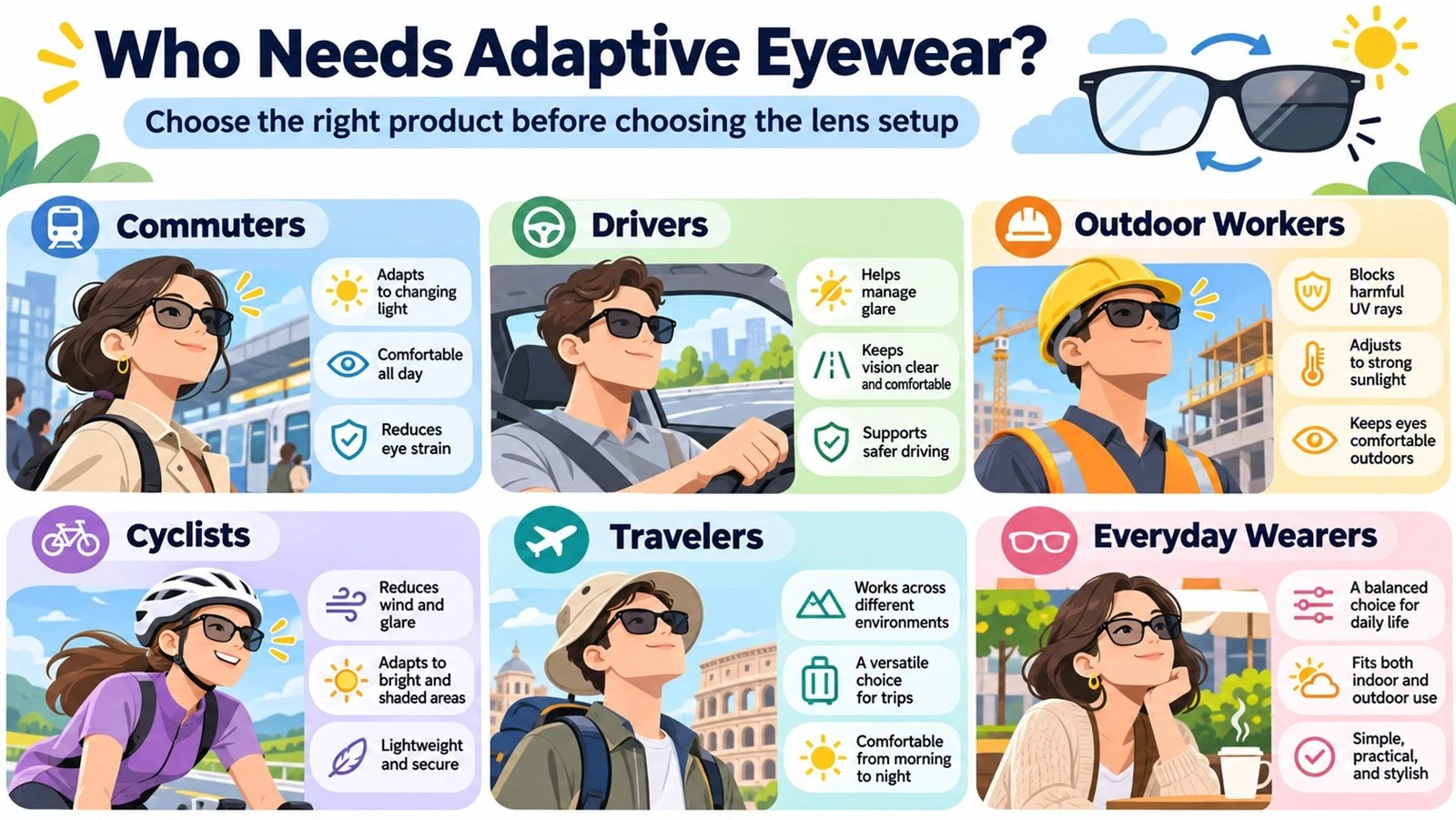
The strongest opportunity for adaptive eyewear is not necessarily the customer who wants the darkest sunglasses. It is the customer who regularly moves between environments with different light levels.
For brands, that distinction determines the product's frame design, lens specifications, price positioning, and sales message.
Match the Product to the Customer's Daily Routine
|
Target Customer |
Typical Usage |
Recommended Product Direction |
Key Buying Consideration |
|---|---|---|---|
|
Urban commuters |
Offices, streets, public transport |
Clear-to-dark everyday eyewear |
Indoor clarity and outdoor comfort |
|
Optical customers |
Prescription wear throughout the day |
Prescription-compatible photochromic frames |
Lens compatibility and optical quality |
|
Outdoor lifestyle consumers |
Walking, travel, casual outdoor activities |
Lightweight adaptive sunglasses |
Darkening performance and UV protection |
|
Cyclists and recreational athletes |
Variable sunlight and shaded routes |
Wraparound TR90 or nylon-frame eyewear |
Coverage, stability and reaction behavior |
|
Fashion-conscious consumers |
Indoor styling and outdoor use |
Acetate or metal frames with adaptive lenses |
Frame aesthetics and tint colors |
|
Drivers |
Extended time behind windshields |
Vehicle-responsive lens technology |
Verified in-car activation and road-use suitability |
These are proposed product-market matches, not market-share forecasts.
Which Market Should an Eyewear Brand Enter First?
For a new private-label eyewear collection, urban lifestyle and optical-inspired designs offer a practical starting point. A single classic frame can suit multiple sales channels, while two lens configurations can serve different price segments.
Sports eyewear requires more specialized development. Lens curvature, ventilation, frame stability, and rapid changes in lighting become more important.
Driving eyewear should be treated as a separate product specification rather than an automatic feature of ordinary photochromic lenses.
Buyer question: "Can we sell the same photochromic glasses to office workers, drivers, and cyclists?"
You can position a versatile model for general daily use, but you should not promise identical performance across all three activities. Driving and cycling introduce different visibility and safety requirements. If these users are central to your brand, develop and validate configurations specifically for those conditions.
What Can Photochromic Lenses Actually Do-and What Are Their Limitations?
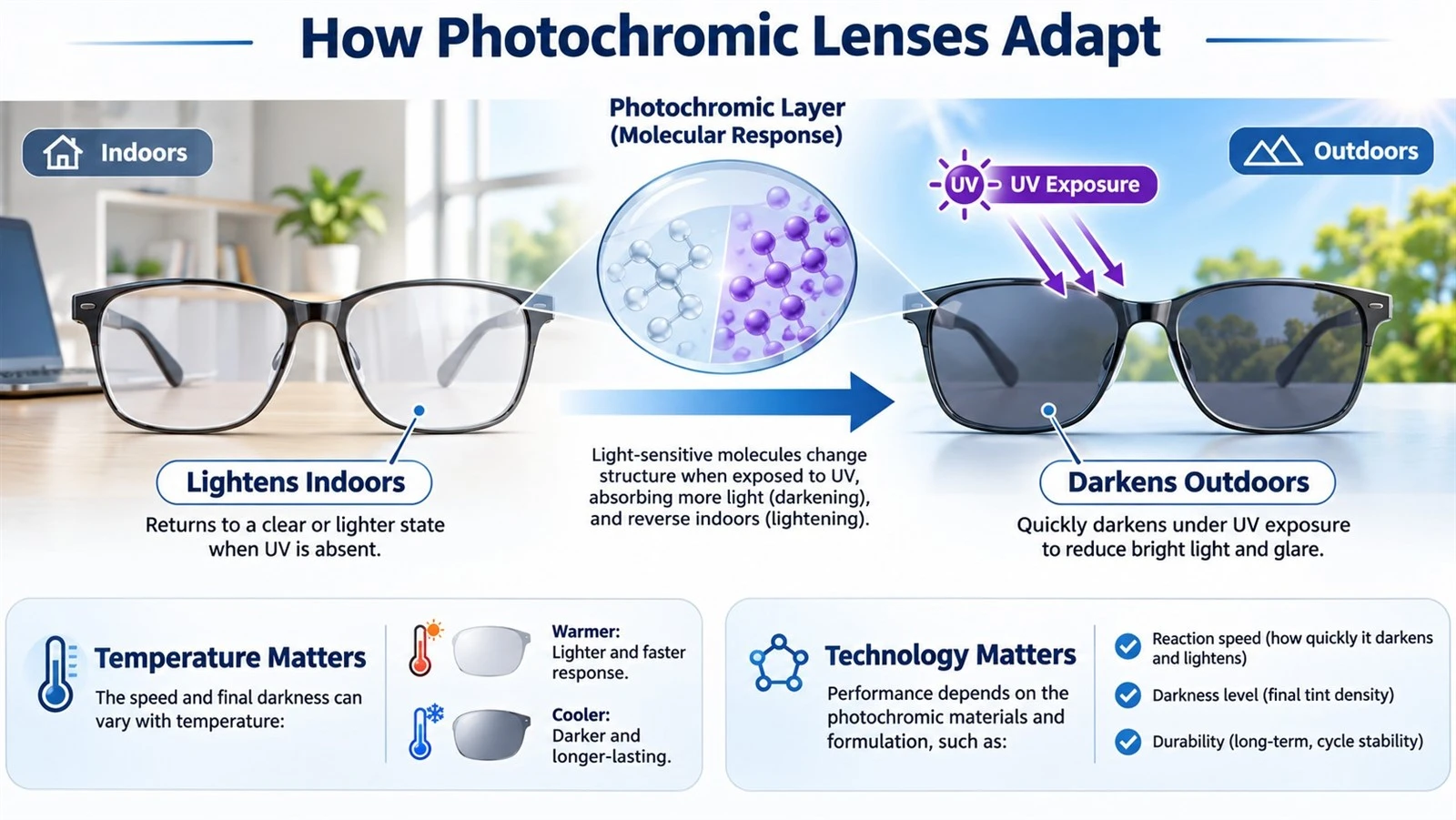
Photochromic lenses contain light-responsive substances that change their optical absorption when exposed to activating light. Many conventional technologies respond primarily to ultraviolet radiation, causing lenses to darken outdoors and become lighter when that exposure decreases.
This is useful for daily eyewear, but it does not mean the lens adjusts instantly or delivers the same darkness everywhere.
Photochromic vs. Adaptive Lens Technologies
Not all light-responsive lenses use exactly the same activation mechanism.
|
Lens Technology |
Indoor Appearance |
Outdoor Performance |
Behind a Windshield |
Main Consideration |
|---|---|---|---|---|
|
Conventional UV-activated photochromic |
Usually clear or nearly clear |
Darkens under sufficient UV exposure |
Often limited activation |
Affordable everyday versatility |
|
UV + visible-light-responsive technology |
May retain a slight residual tint |
Can achieve stronger darkness, depending on formulation |
May darken under suitable conditions |
Useful for more demanding light environments |
|
Photochromic polarized technology |
Depends on the specific system |
Changes tint and can provide polarization |
Product-dependent |
Higher technical complexity and validation requirements |
|
Fixed-tint sunglasses |
Permanently tinted |
Consistent tint under the same conditions |
No automatic adjustment |
Suitable when adaptive behavior is unnecessary |
Transitions Optical explains that certain technologies, including XTRActive, respond to both UV and visible light, allowing activation behind some vehicle windshields. This is a technology-specific capability, not a property of every photochromic lens.
Four Performance Limitations Buyers Must Understand
1. Temperature affects lens darkness.
Some photochromic formulations reach a darker state in cooler conditions and become less dark under high temperatures. The degree of temperature dependence varies by technology.
For brands selling to customers in hot climates, performance at elevated temperatures deserves particular attention.
2. Activation and fading are not instantaneous.
A lens may darken relatively quickly but require longer to return to its lighter state. These are separate performance characteristics and should be tested independently.
3. Standard photochromic lenses may not work well inside vehicles.
Many windshields reduce the UV radiation needed to activate conventional lenses. Brands targeting drivers should request documented in-car performance rather than relying on general product descriptions.
4. Photochromic technology does not automatically guarantee better UV protection.
UV protection and visible-light darkening are distinct specifications. A lens can provide UV protection while remaining nearly clear, and a dark-looking lens should never be assumed to provide adequate UV protection without testing.
How Should Brands Choose Photochromic Lens Materials, Colors, and Coatings?
Choosing photochromic lenses involves more than deciding whether they should turn gray or brown. Lens substrate, photochromic formulation, coating compatibility, and optical specifications all influence the finished product.
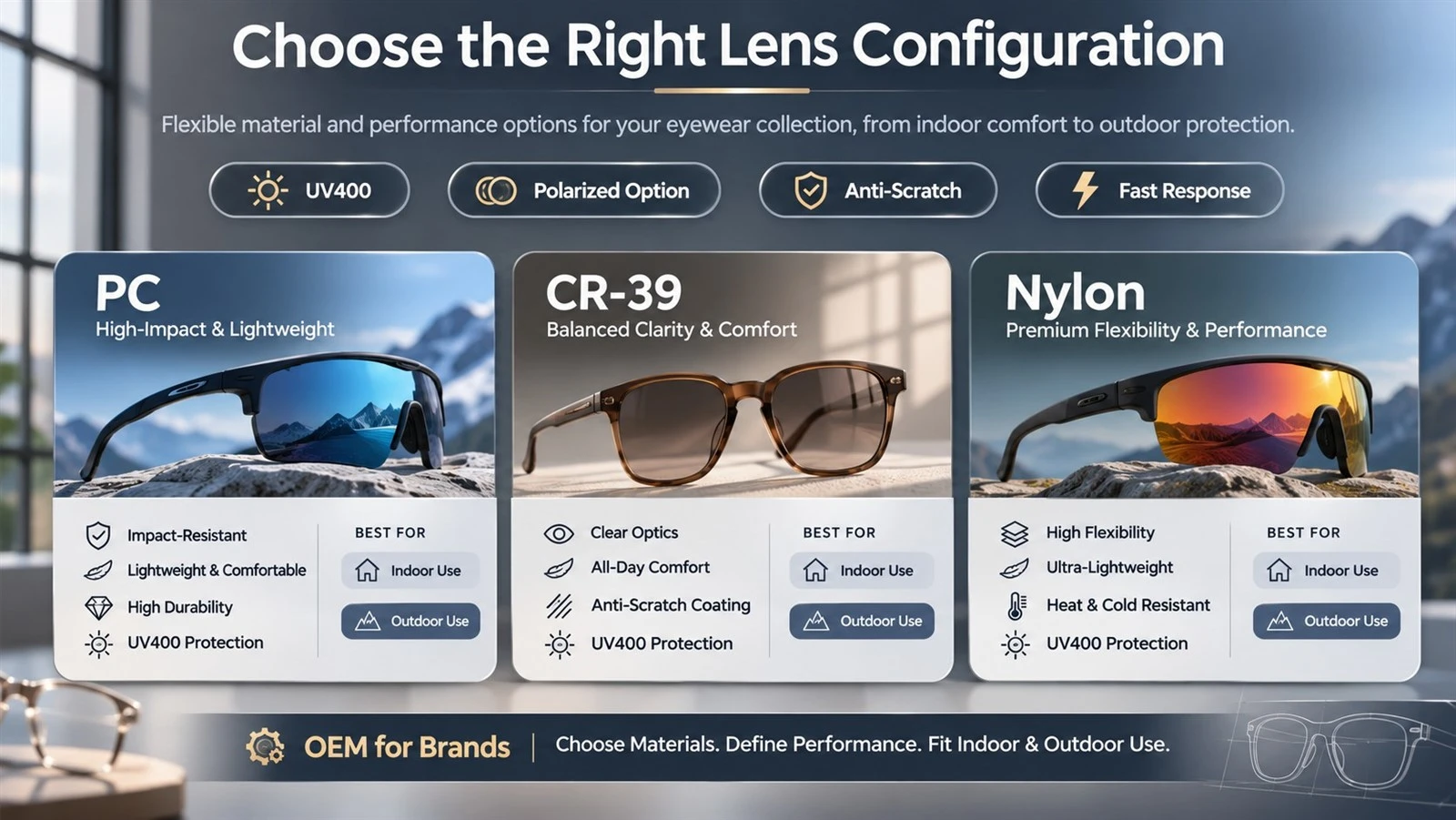
1. Compare Lens Materials Before Choosing the Frame
|
Lens Material |
Main Advantages |
Development Considerations |
Suitable Positioning |
|---|---|---|---|
|
Polycarbonate (PC) |
Lightweight, good impact resistance |
Confirm photochromic technology and coating compatibility |
Everyday and active lifestyle eyewear |
|
CR-39 / Resin |
Good optical clarity and established ophthalmic applications |
Generally thicker than high-index alternatives for equivalent prescriptions |
Optical-inspired and prescription collections |
|
Nylon / Polyamide |
Lightweight, suitable for certain curved sport-lens designs |
Availability of compatible photochromic formulations must be confirmed |
Premium sports and outdoor eyewear |
|
High-index optical resin |
Thinner lenses for certain prescription powers |
More specialized processing and potentially higher costs |
Premium prescription eyewear |
Material availability is supplier-specific. A factory offering ordinary PC or nylon sunglasses cannot necessarily provide every photochromic technology in the same material.
Buyer question: "We already use TAC polarized lenses. Can we simply replace them with photochromic lenses?"
Not necessarily. Standard TAC polarized lenses and photochromic lenses may have different constructions, processing requirements, and optical properties. A photochromic-polarized combination requires a specifically engineered solution, not simply the substitution of one lens film.
2. Select Lens Colors According to Product Positioning
- Gray: A versatile option for everyday use, maintaining a relatively neutral color appearance.
- Brown: Suitable for brands emphasizing a warmer visual tone and classic lifestyle styling.
- Green: A distinctive option for heritage-inspired or fashion-oriented eyewear.
Specialty colors such as blue or purple may also be available, depending on the lens technology.
Different colors may exhibit different transmission characteristics. Brands should compare actual faded and activated samples rather than assume that every color reaches an identical darkness.
For a first collection, gray and brown offer two understandable product directions without unnecessarily expanding the number of SKUs.
3. Choose Functional Coatings Carefully
Anti-reflective coatings can reduce reflections, particularly on lenses intended for frequent indoor use. Hard coatings can improve surface durability, while hydrophobic or oleophobic treatments make cleaning easier.
These coatings add value when they solve a specific customer problem. However, not every coating stack is compatible with every photochromic material or processing method.
How Can Frame Design Support an Indoor–Outdoor Eyewear Collection?
A photochromic lens cannot compensate for an uncomfortable or poorly designed frame.
Someone wearing the same glasses throughout the day needs a frame that feels appropriate at a desk, on the street, and during ordinary outdoor activities.
Choose Frame Materials by Usage Scenario
Acetate frames work well for fashion-oriented and premium lifestyle collections. Their color depth and design possibilities allow brands to create distinctive products that resemble everyday optical glasses indoors and fashionable sunglasses outdoors.
TR90 frames are suitable for lightweight daily eyewear and certain active applications. Flexible frame construction can improve wearing comfort, although fit depends on the complete design rather than material alone.
Metal frames offer slimmer profiles for minimalist optical-inspired collections. Nose-pad design, weight distribution, and lens retention require careful evaluation.
PC frames can provide an economical option for selected casual and promotional products, subject to the intended fit and durability requirements.
Brands can explore existing wholesale optical eyewear frames and sunglasses designs before committing to original tooling.
Match Frame Geometry to Lens Performance
For everyday use, moderate lens curvature and balanced coverage are often practical starting points.
Sports designs may require deeper wraparound coverage, curved lenses, and increased stability. These characteristics introduce additional requirements for optical geometry, photochromic lens availability, and lens processing.
Before approving a frame, ask:
- Is the lens size and base curve compatible with the chosen photochromic material?
- Does the frame provide sufficient outdoor coverage without becoming unsuitable for indoor use?
- Will the nose pads and temples remain comfortable during extended wear?
- Can the lens be securely mounted without excessive stress or deformation?
A useful development strategy is to build a small collection around one proven frame platform, then introduce different photochromic lens configurations.
This helps control tooling costs and reduces variation during production.
What Can Brands Customize Through Photochromic Eyewear OEM/ODM?
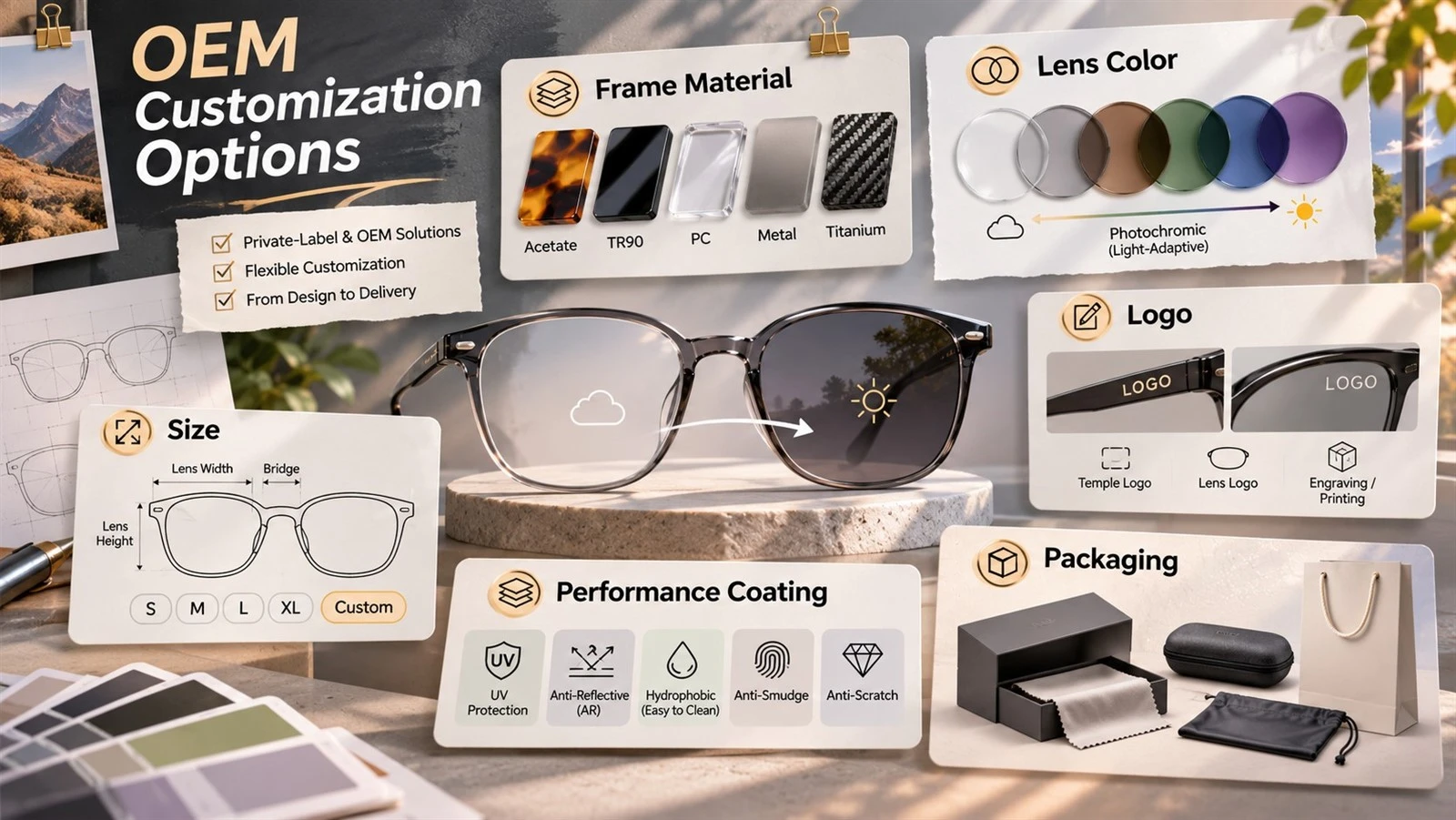
Photochromic eyewear customization extends beyond placing a logo on an existing frame.
The important distinction is between changes that affect appearance and changes that affect the optical or mechanical performance of the finished glasses.
Available OEM/ODM Customization Options
|
Customization |
Options to Discuss |
Production Complexity |
|---|---|---|
|
Frame material |
Acetate, TR90, metal, PC |
Medium to high if changing construction |
|
Frame color |
Existing colors, custom colors, patterns |
Low to medium |
|
Lens specification |
Photochromic technology, substrate, tint |
Medium to high |
|
Lens coating |
Anti-reflective, hard coating, easy-clean |
Medium to high |
|
Brand logo |
Laser marking, screen printing, hot stamping, metal decoration |
Low to high depending on method |
|
Frame dimensions |
Lens size, bridge, temple length |
High if tooling changes are required |
|
Packaging |
Cases, pouches, cleaning cloths, retail boxes |
Generally low to medium |
|
Original frame design |
New shape, hinges, molds and components |
High |
These complexity levels are indicative; the actual requirements depend on the selected construction and production resources.
Which Customizations Should Come First?
For a new brand, changing the frame color, adding a temple logo, and designing retail packaging is often more economical than creating an entirely new mold.
Lens customization deserves separate consideration. Changing from a conventional photochromic lens to a vehicle-responsive or polarized version can affect sourcing, testing, lead time, and unit cost.
Finewell Eyewear provides OEM/ODM eyewear customization services, including frame design, branding, material selection, and packaging development. Lens technology and performance requirements should be reviewed during the quotation stage.
How Do OEM Specifications Affect MOQ, Cost, and Lead Time?
The quoted price of photochromic glasses depends on far more than the frame material.
The same frame may require substantially different sourcing and processing arrangements depending on whether it uses a standard photochromic lens, a specialized visible-light-responsive lens, or a more complex polarized photochromic construction.
Compare Three OEM Development Approaches
|
Development Option |
Relative Cost |
MOQ Considerations |
Lead-Time Considerations |
|---|---|---|---|
|
Existing frame + available photochromic lens |
Lower |
May support smaller trial orders |
Usually the simplest route |
|
Existing frame + customized lens specification |
Medium |
Depends on lens availability and customization |
Additional sourcing and validation |
|
Original frame + specialized photochromic lens |
Higher |
May require tooling and component minimums |
Longer development and approval process |
These are comparative sourcing scenarios, not fixed Finewell pricing or MOQ commitments.
What Usually Increases OEM Costs?
Four factors deserve special attention.
Lens specification: Specialized formulations, substrates, and coatings may cost more than standard photochromic lenses.
Tooling: New frame molds, custom components, and structural modifications can introduce one-time engineering expenses.
SKU complexity: Ordering five frame colors with three lens options creates 15 potential combinations. That can complicate inventory and increase minimum purchases of individual components.
Testing: Laboratory testing, documentation, and sample revisions should be included in the project budget.
How Should Buyers Request a Quotation?
Instead of asking only for a unit price, request comparable quotations at several quantities.
For example, ask the manufacturer to price 100, 300, and 1,000 pairs under the same approved product specification. These are illustrative quotation volumes, not guaranteed MOQs.
Require each quotation to identify tooling costs, sample costs, lens specifications, packaging, testing responsibilities, production lead time, and shipping terms.
This makes it easier to compare the true landed-cost structure and determine whether the project is commercially viable.
What Is the OEM Development Process for a Photochromic Eyewear Collection?
A structured development process prevents unnecessary redesign and reduces the risk of approving an attractive product with unsuitable optical performance.
1. Define the target customer.
Identify the intended market, daily activities, selling price, distribution channel, and whether prescription compatibility is needed.
2. Select the lens technology.
Confirm the substrate, photochromic formulation, colors, coating options, and target transmission performance.
3. Choose or develop the frame.
Review existing frame designs before investing in original tooling. Confirm compatibility with the selected lens.
4. Prepare a complete OEM specification.
Include dimensions, materials, branding positions, packaging requirements, required tests, and intended market.
5. Produce and evaluate samples.
Inspect appearance, fit, assembly, and photochromic performance. Record any requested modifications.
6. Approve the production reference.
Confirm the final sample, test documentation, component specifications, and commercial terms.
7. Begin production and quality control.
Verify incoming lenses and frames, assembly consistency, packaging, and final product requirements before shipment.
For private-label brands, the most important milestone is not receiving the first sample. It is approving a specification that can be reproduced consistently in subsequent orders.
Frequently Asked Questions About Photochromic Eyewear OEM
1) Can Photochromic Glasses Be Completely Clear Indoors?
Some formulations are designed to become very clear indoors, while others retain a noticeable residual tint.
The actual result depends on the technology, lens material, coatings, and lighting conditions. Request clear-state transmittance data and physical samples before making a completely-clear claim.
2) Can Photochromic Sunglasses Be Customized With a Brand Logo?
Yes. Depending on the frame material, brands can explore laser marking, screen printing, hot stamping, and decorative metal logos.
Temple branding is generally a practical starting point. Branding directly on lenses requires additional consideration of optical quality, placement, durability, and applicable standards.
3) Are Photochromic Lenses Suitable for Driving?
Some specialized photochromic technologies can activate behind windshields, but conventional UV-responsive lenses may not darken sufficiently inside vehicles.
Night-driving suitability is also a separate consideration. Brands should verify road-use requirements and actual transmittance performance rather than advertise all photochromic lenses as suitable for driving.
4) Is It Better to Choose Photochromic or Polarized Sunglasses?
The answer depends on the intended activity.
Photochromic technology adjusts lens darkness under activating light conditions. Polarization is designed to reduce certain reflected glare. These functions solve different problems.
For everyday indoor–outdoor use, photochromic lenses may be more convenient. For activities involving strong reflected glare, polarized lenses may be preferable.
Some systems combine both functions, but product availability, performance, and costs must be evaluated individually.
Build Your Photochromic Eyewear Collection With the Right OEM Specifications
A successful photochromic eyewear collection is not defined by how dark its lenses become. It is defined by how reliably the complete product performs for its intended customer.
Brands should establish the target usage scenario, select compatible lens and frame materials, verify optical performance, and approve reproducible specifications before committing to volume production.
At Finewell Eyewear, we support B2B buyers developing private-label and customized eyewear, from frame selection and logo customization to packaging, production coordination, and international shipping.
Whether you are planning a small branded collection or developing an original OEM design, the starting point is a clear technical brief.
Contact Finewell Eyewear for Three OEM Quotation Options:
- Option A – Entry Collection: Existing frame designs with available photochromic lens options.
- Option B – Customized Collection: Selected frame colors, branding, packaging, and specified lens features.
Option C – Original OEM/ODM Collection: Custom frame development and specialized lens requirements, subject to feasibility review.
Send us your target market, preferred frame style, estimated order quantity, and desired lens performance. Our team can review feasible configurations, sampling requirements, MOQ, and production schedules before preparing a quotation.
No Information


